header-logo header-logo

03 December 2020 / Dr Jon Robins
Issue: 7913 / Categories: Opinion , Criminal
printer mail-detail

A Royle fight for justice

33607
Jon Robins , speaking to actor Ricky Tomlinson, investigates and provides an update on the case of the Shrewsbury 24

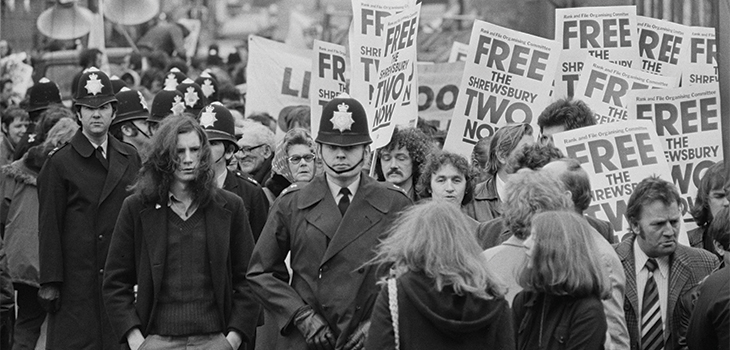
The actor Ricky Tomlinson must be nearing, if he hasn’t already achieved, ‘national treasure’ status; however the star of Royle Family, Brookside and many other hit shows has also been engaged in a 47-year fight for justice after being jailed in relation to his role as a trade union activist during the 1972 builders strike. Earlier this year the miscarriage of justice watchdog finally referred his conviction, along with six other members of a group of construction workers otherwise known as the ‘Shrewsbury 24’, back to the Court of Appeal.

They had been picketing sites in Shrewsbury and had been charged under arcane legislation, the Conspiracy Act 1875, for offences relating to intimidation and damage during the first nationwide industrial action by the building trade. It was a fraught time of growing union militancy and the government was increasingly panicky when Ricky Tomlinson took part in the first ever national building workers’

If you are not a subscriber, subscribe now to read this content
If you are already a subscriber sign in
...or Register for two weeks' free access to subscriber content

MOVERS & SHAKERS

NLJ Career Profile: Ken Fowlie, Stowe Family Law

NLJ Career Profile: Ken Fowlie, Stowe Family Law

Ken Fowlie, chairman of Stowe Family Law, reflects on more than 30 years in legal services after ‘falling into law’

Jackson Lees Group—Jannina Barker, Laura Beattie & Catherine McCrindle

Jackson Lees Group—Jannina Barker, Laura Beattie & Catherine McCrindle

Firm promotes senior associate and team leader as wills, trusts and probate team expands

Asserson—Michael Francos-Downs

Asserson—Michael Francos-Downs

Manchester real estate finance practice welcomes legal director

NEWS
Children can claim for ‘lost years’ damages in personal injury cases, the Supreme Court has held in a landmark judgment
Holiday lets may promise easy returns, but restrictive covenants can swiftly scupper plans. Writing in NLJ this week, Andrew Francis of Serle Court recounts how covenants limiting use to a ‘private dwelling house’ or ‘private residence’ have repeatedly defeated short-term letting schemes
Artificial intelligence (AI) is already embedded in the civil courts, but regulation lags behind practice. Writing in NLJ this week, Ben Roe of Baker McKenzie charts a landscape where AI assists with transcription, case management and document handling, yet raises acute concerns over evidence, advocacy and even judgment-writing
The cab-rank rule remains a bulwark of the rule of law, yet lawyers are increasingly judged by their clients’ causes. Writing in NLJ this week, Ian McDougall, president of the LexisNexis Rule of Law Foundation, warns that conflating representation with endorsement is a ‘clear and present danger’
The Supreme Court has drawn a firm line under branding creativity in regulated markets. In Dairy UK Ltd v Oatly AB, it ruled that Oatly’s ‘post-milk generation’ trade mark unlawfully deployed a protected dairy designation. In NLJ this week, Asima Rana of DWF explains that the court prioritised ‘regulatory clarity over creative branding choices’, holding that ‘designation’ extends beyond product names to marketing slogans
back-to-top-scroll