header-logo header-logo

28 July 2023 / John Pointing
Issue: 8035 / Categories: Features , Profession , Environment
printer mail-detail

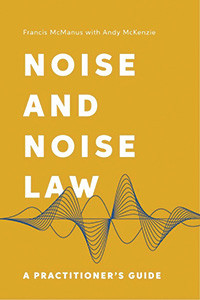
Book review: Noise & Noise Law: A Practitioner’s Guide

132278
"A second edition of this useful book may be needed before too long"
  • Authors: Francis McManus & Andy Mckenzie
  • Publisher: Edinburgh University Press
  • ISBN: 9781399505055
  • RRP: £60

Complaints about noise nuisance resulting from the activities of neighbours form the largest category of nuisance complaints made to local authorities. The issuing of community protection notices under the Anti-social Behaviour, Crime and Policing Act 2014 by the police and local authorities is driven by the desire to control behaviour-driven noise, ranging from being ‘significantly annoying’ for those living and working in the neighbourhood, to behaviour amounting to public disorder. Liability for causing nuisance or anti-social behaviour is contingent on whether acts (or omissions) are deemed unreasonable—a highly elastic concept, dependent on the circumstances of the particular case, and resistant to precise definition.

Nuisance law has proved challenging to legislators and judges, since people have had to live in close proximity to others and where residential uses of land meet the boundaries of other uses, such as

If you are not a subscriber, subscribe now to read this content
If you are already a subscriber sign in
...or Register for two weeks' free access to subscriber content

MOVERS & SHAKERS

Clarke Willmott—Matthew Roach

Clarke Willmott—Matthew Roach

Partner joins commercial property team in Taunton office

Farrer & Co—Richard Lane

Farrer & Co—Richard Lane

Londstanding London firm appoints new senior partner

Bird & Bird—Sue McLean

Bird & Bird—Sue McLean

Commercial team in London welcomes technology specialist as partner

NEWS
What safeguards apply when trust corporations are appointed as deputy by the Court of Protection? 
Disputing parties are expected to take part in alternative dispute resolution (ADR), where this is suitable for their case. At what point, however, does refusing to participate cross the threshold of ‘unreasonable’ and attract adverse costs consequences?
When it comes to free legal advice, demand massively outweighs supply. 'Millions of people are excluded from access to justice as they don’t have anywhere to turn for free advice—or don’t know that they can ask for help,' Bhavini Bhatt, development director at the Access to Justice Foundation, writes in this week's NLJ
When an ex-couple is deciding who gets what in the divorce or civil partnership dissolution, when is it appropriate for a third party to intervene? David Burrows, NLJ columnist and solicitor advocate, considers this thorny issue in this week’s NLJ
NLJ's latest Charities Appeals Supplement has been published in this week’s issue
back-to-top-scroll