header-logo header-logo

23 May 2025 / Graeme Hydari
Issue: 8117 / Categories: Features , Legal aid focus , Profession
printer mail-detail

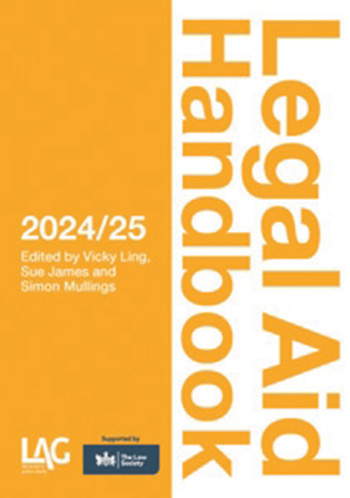
Book review: Legal Aid Handbook 2024/25

219523
"No required information on legal aid is left uncovered in this handbook"
  • Authors: Vicky Ling, Sue James and Simon Mullings
  • Publisher: Legal Action Group
  • ISBN: 9781913648688
  • RRP: £85

As a legal aid practitioner who has worked in criminal legal aid for over 40 years, several thoughts came to mind while reviewing the excellent and thorough Legal Aid Handbook.

One item of note is the change from paper to digital over the years, regarding applications, costs, management, and just how complicated the administration of the legal aid system has become. This results in this handbook necessitating 698 pages of vital information, plus an index. It resembles the unwieldly tax manuals, but in this case, it sets out the information in a neat, logical and accessible form.

I am also reminded of the importance of legal aid funding to those seeking legal help and justice, but balanced against the need to prevent the misuse of the public money made available for such help.

Essential knowledge

Unfortunately,

If you are not a subscriber, subscribe now to read this content
If you are already a subscriber sign in
...or Register for two weeks' free access to subscriber content

MOVERS & SHAKERS

Thomson Hayton Winkley—Jordan Wallace

Thomson Hayton Winkley—Jordan Wallace

Thomson Hayton Winkley strengthens family law team

Ward Hadaway—Barnaby Rosenthall

Ward Hadaway—Barnaby Rosenthall

Construction lawyer returns to Ward Hadaway in Teesside role

Bird & Bird—Shahin Baghaei

Bird & Bird—Shahin Baghaei

Bird Bird hires leading legal transformation expert

NEWS
Legal aid deserts leave almost one in four without adequate access to justice
The Solicitors Regulation Authority (SRA) has warned solicitors and law firms that using artificial intelligence does not alter their professional obligations, amid concerns over inaccurate legal material and client confidentiality
From forgotten interest claims to case-management appeals, a string of procedural developments offers useful—and occasionally cautionary—lessons for practitioners

Jonathan Fisher KC highlights that it now accounts for around 40% of criminal offences, with roughly 70% involving technology, and argues that the UK cannot simply prosecute its way out of the problem. Detection, investigation and prosecution all require improvement, while different fraud types demand tailored responses.

How forcefully can a litigant criticise a public authority before robust advocacy crosses the line into unreasonable conduct? 
back-to-top-scroll