Drug and alcohol misuse is a common feature in family court proceedings, with implications for safeguarding, contact, and parenting capacity. Laboratory testing provides vital evidence, but only when the right test is selected.
Different testing methods detect different substances over varying timeframes. A test that’s too specific, too broad, or poorly matched to the case may miss key information or lead to misinterpretation. For legal professionals, knowing which test to use in a particular scenario is essential for building a clear evidential picture and supporting safe, timely decisions in the best interests of children or other vulnerable people.
Understanding the range of tests available
AlphaBiolabs offers the UK’s most comprehensive portfolio of drug and alcohol testing services for family law professionals.
Our laboratory can test sample types including hair, nails, oral fluid, urine, blood, and breath. We also offer SCRAM Continuous Alcohol Monitoring® (SCRAM CAM®).
Each testing method differs by:
- Detection window: how far back substance use can be detected
- Sample type: what is available or appropriate for the sample donor to provide
- Application: whether the test aims to confirm abstinence, detect recent use, or identify longer-term patterns of behaviour
Choosing the right test depends on the substances involved, the sample types available, and the evidence required by the court.
Narrow vs wide-window testing
Drug and alcohol tests fall broadly into two categories: narrow-window and wide-window testing, based on how far back substance use can be detected.
Narrow-window tests detect recent or very recent use, from a few hours to several days, and are ideal for point-of-care/pre-contact checks, unannounced testing, or short-term compliance.
Wide-window tests detect longer-term patterns of use, and are useful for assessing abstinence, long-term behaviour, or chronic misuse.
Choosing between narrow-window and wide-window methods depends on what the court needs to establish. In many cases, a combination of test types offers the most in-depth picture.
Practical considerations
Selecting the right test involves more than just timeframe. Other key factors include the reason for the test, sample availability, court requirements, and whether repeat testing is needed.
- Purpose: Is the test to demonstrate abstinence, recent use, or patterns over time?
- Sample type: What is the best sample type to test? What are the other options if the preferred sample type isn’t viable?
- Frequency: One-off testing may suffice for some cases. Others, such as those involving supervision or safeguarding, may benefit from ongoing monitoring or a combination of test types.
Matching the method to the case ensures results are relevant, reliable, and court admissible.
A new resource for legal professionals
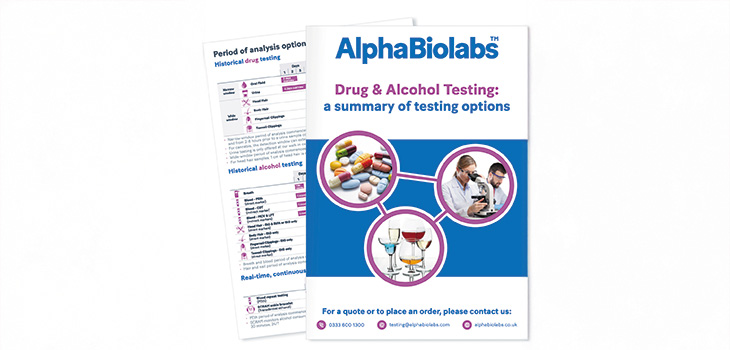
At AlphaBiolabs, we recognise that the wide range of testing options available can be confusing, and that selecting the most appropriate test for a particular scenario is not always straightforward. We have therefore developed a new, free reference guide specifically for family law professionals: Drug & Alcohol Testing: a summary of testing options
This user-friendly and highly practical resource includes:
- Side-by-side comparison of test types and detection windows
- Explanation of alcohol biomarkers and what can be reported
- Explanation of segmented vs overview hair testing
To request hard or digital copies of the guide, or to request a quote for drug & alcohol testing, call our New Enquiry team on 0333 600 1300, email testing@alphabiolabs.com, or complete our online quote form athttps://www.alphabiolabs.co.uk/legal-test-forms/.
Image: © Shutterstock