header-logo header-logo

22 July 2022 / Mark Pawlowski
Issue: 7988 / Categories: Features , Profession
printer mail-detail

The lawyer in popular film

88152
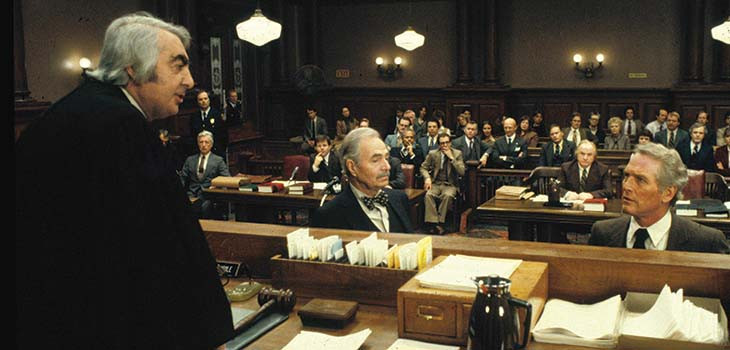
Mark Pawlowski takes a close look at The Verdict, a classic film portraying the lawyer hero in popular culture

The Verdict, released in 1982, revolves around the redemption of a hack lawyer, Frank Galvin (played by Paul Newman), whose life is eventually turned around by a personal injury action in which he represents a young woman who is permanently comatose because a doctor gave her the wrong anaesthesia. Essentially, the film delivers an answer, a verdict to the question, who is Frank Galvin?

Frank has fallen on bad times, divorced by his wife, middle-aged and a heavy drinker, he resorts to finding cases by going to funeral parlours and wakes to tout for business. He has had only four cases in the last three years—all of which he has lost. His last chance at salvation is the medical practice case which has fortuitously come his way. The case is significant because it contains a strong moral element—the paralysis of a patient by a negligent doctor. At first, Frank is

If you are not a subscriber, subscribe now to read this content
If you are already a subscriber sign in
...or Register for two weeks' free access to subscriber content

MOVERS & SHAKERS

Thomson Hayton Winkley—Jordan Wallace

Thomson Hayton Winkley—Jordan Wallace

Thomson Hayton Winkley strengthens family law team

Ward Hadaway—Barnaby Rosenthall

Ward Hadaway—Barnaby Rosenthall

Construction lawyer returns to Ward Hadaway in Teesside role

Bird & Bird—Shahin Baghaei

Bird & Bird—Shahin Baghaei

Bird Bird hires leading legal transformation expert

NEWS
Legal aid deserts leave almost one in four without adequate access to justice
The Solicitors Regulation Authority (SRA) has warned solicitors and law firms that using artificial intelligence does not alter their professional obligations, amid concerns over inaccurate legal material and client confidentiality
From forgotten interest claims to case-management appeals, a string of procedural developments offers useful—and occasionally cautionary—lessons for practitioners

Jonathan Fisher KC highlights that it now accounts for around 40% of criminal offences, with roughly 70% involving technology, and argues that the UK cannot simply prosecute its way out of the problem. Detection, investigation and prosecution all require improvement, while different fraud types demand tailored responses.

How forcefully can a litigant criticise a public authority before robust advocacy crosses the line into unreasonable conduct? 
back-to-top-scroll