Drug misuse remains a recurrent feature in family proceedings, often shaping decisions around safeguarding, supervision and contact.
However, the substance abuse landscape is no longer confined to heroin, cocaine, and cannabis. Toxicology laboratories are seeing an increase in controlled prescription drug misuse, the continued emergence of New Psychoactive Substances (NPS), and a marked rise in poly-drug use.
In addition, street drugs are increasingly adulterated or contaminated, meaning individuals may be unaware of the full range of substances they have consumed, many of which fall outside standard drug testing panels and may not be detected unless specifically requested.
For legal practitioners, it is no longer enough to know whether someone has taken a drug. Understanding what that drug is, how it is classified, and how it is typically used is equally important.
Legislative classifications
In family cases, how a substance is classified under UK law can have a real bearing on how risk is assessed and how evidence is framed.
- The principal legislative framework remains the Misuse of Drugs Act 1971 (MDA), which categorises controlled drugs as Class A, B or C according to their assessed harm.
- The Psychoactive Substances Act 2016 (PSA) was introduced to address the proliferation of so-called ‘legal highs’, synthetic substances designed to mimic the effects of controlled drugs.
- The Human Medicines Regulations 2012 govern prescription-only medicines that are not controlled under the MDA but may still be subject to misuse.
Importantly, legal status does not necessarily reflect safeguarding risk. A substance may be lawfully prescribed, yet misused in a manner that impairs cognition, behaviour, or parenting capacity.
Key drug groups now appearing in family cases
While traditional illicit drugs remain relevant, family practitioners are increasingly encountering a broader spectrum of substances in legally-instructed testing:
- Opioids feature prominently, ranging from heroin to prescribed medications such as methadone, buprenorphine and fentanyl. Although many of these drugs have legitimate therapeutic roles (e.g. opioid substitution therapy, pain management), misuse carries significant risks.
- Cannabinoids now extend beyond cannabis to include synthetic variants such as ‘Spice’, often associated with unpredictable behavioural effects.
- Hallucinogens including ketamine are appearing more frequently.
We are also seeing increasing misuse of prescription-only medications including anticonvulsants like gabapentin and pregabalin, antidepressants, antipsychotics, and anabolic steroids.
These substances may be lawfully prescribed, yet excessive or non-prescribed use can contribute to mood instability, cognitive impairment, or behavioural volatility.
Why this matters when instructing drug tests
Understanding the main drug groups can help shape the scope of testing instructed and avoid gaps in the evidential picture.
Standard drug panels are designed to detect the most misused controlled substances. However, where prescription drug misuse, synthetic cannabinoids, or emerging psychoactive substances are suspected, an extended panel may be required.
Results must also be interpreted within clinical and behavioural context. The presence of a prescribed medication does not automatically indicate misuse; conversely, lawful access does not negate safeguarding concerns.
A new reference guide for legal professionals
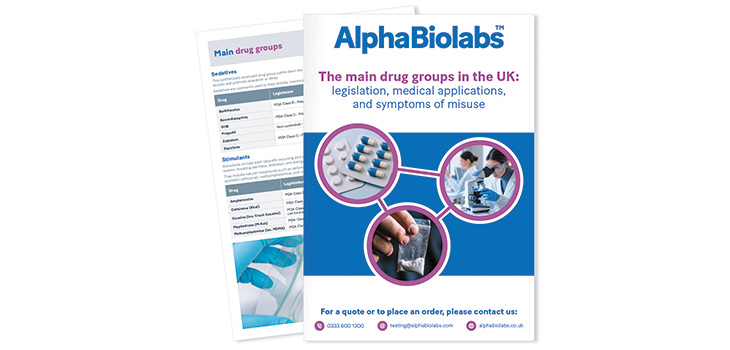
In response to demand for our previous guide, Drug & Alcohol Testing: a summary of testing options, we have developed a complementary guide for family law professionals: The main drug groups in the UK: legislation, medical applications and symptoms of misuse.
The guide provides:
- A breakdown of the main drug groups and classifications
- Details of medical conditions for which listed drugs may be prescribed
- Most common symptoms of misuse (by drug group)
To request print or digital copies of either guide, or to request a quote for drug & alcohol testing, call our New Enquiry team on 0333 600 1300, email testing@alphabiolabs.com, or complete our online quote form athttps://www.alphabiolabs.co.uk/legal-test-forms/.
Image: © Shutterstock