header-logo header-logo

12 December 2025 / Nicky Hunter
Issue: 8143 / Categories: Features , Family , Divorce
printer mail-detail

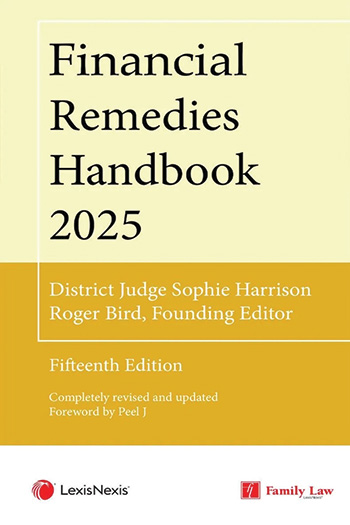
Book review: Financial Remedies Handbook 2025, 15th Edition

238278

“The Handbook is an indispensable guide for all financial remedy practitioners working at all levels”

  • Author: District Judge Sophie Harrison
  • Publisher: Jordan Publishing
  • ISBN: 9781474333672
  • RRP: £228

Recently released in its 15th edition, the Financial Remedies Handbook, authored for the first time solely by District Judge Sophie Harrison following the retirement of Roger Bird, is an indispensable guide for all financial remedy practitioners working at all levels. As the publishers Jordan Publishing highlight, this revised edition provides a ‘complete review of the legal principles and the s 25 Matrimonial Causes Act 1973 factor and how they apply in practice, and a full overview of the powers of the court to make orders on divorce and dissolution’.

Comprehensive coverage

I was fortunate to be reviewing this book during a couple of weeks when I was preparing for hearings and working on some knotty financial remedy issues. The comprehensive list of contents at the beginning of the book made it quick and easy

If you are not a subscriber, subscribe now to read this content
If you are already a subscriber sign in
...or Register for two weeks' free access to subscriber content

MOVERS & SHAKERS

Thomson Hayton Winkley—Jordan Wallace

Thomson Hayton Winkley—Jordan Wallace

Thomson Hayton Winkley strengthens family law team

Ward Hadaway—Barnaby Rosenthall

Ward Hadaway—Barnaby Rosenthall

Construction lawyer returns to Ward Hadaway in Teesside role

Bird & Bird—Shahin Baghaei

Bird & Bird—Shahin Baghaei

Bird Bird hires leading legal transformation expert

NEWS
The Solicitors Regulation Authority (SRA) has warned solicitors and law firms that using artificial intelligence does not alter their professional obligations, amid concerns over inaccurate legal material and client confidentiality
From forgotten interest claims to case-management appeals, a string of procedural developments offers useful—and occasionally cautionary—lessons for practitioners

Jonathan Fisher KC highlights that it now accounts for around 40% of criminal offences, with roughly 70% involving technology, and argues that the UK cannot simply prosecute its way out of the problem. Detection, investigation and prosecution all require improvement, while different fraud types demand tailored responses.

How forcefully can a litigant criticise a public authority before robust advocacy crosses the line into unreasonable conduct? 
Can a meticulously maintained spreadsheet turn a couple’s informal financial arrangements into legally enforceable obligations? 
back-to-top-scroll