header-logo header-logo

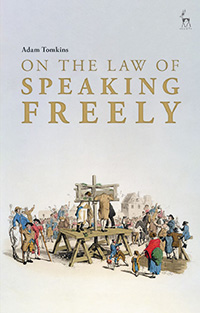
Book review: On the Law of Speaking Freely

24 October 2025 / Charles Wynn-Evans
Issue: 8136 / Categories: Features , Human rights
printer mail-detail
233182
"This book displays an admirably succinct mastery of its inherently controversial subject matter"
  • Author: Professor Adam Tomkins
  • Publisher: Bloomsbury Publishing
  • ISBN: 9781509972104
  • RRP: £24.99

Free speech is undoubtedly one of the most important and controversial issues of our time. ‘Cancel culture,’ the gender-critical/realist debate, the definition of Islamophobia, prosecutorial decisions in relation to the Public Order Act 1986 offences concerning threatening or abusive behaviour and harassment, alarm, or distress, and the scope and application of the Online Safety Act 2023—these all, in different ways, bring into sharp focus the controversies that arise in relation to free speech, whether in the context of online safety, media regulation, educational environments, or the workplace.

The controversy, and on occasion toxicity, that can accompany discussion of free speech cries out for a detailed analytical assessment of the legal aspects of the issue. This new work by Professor Adam Tomkins, John Millar Chair of Public Law at the University of Glasgow, rises impressively to this challenge, adroitly and fluently placing

If you are not a subscriber, subscribe now to read this content
If you are already a subscriber sign in
...or Register for two weeks' free access to subscriber content

MOVERS & SHAKERS

Red Lion Chambers—Maurice MacSweeney

Red Lion Chambers—Maurice MacSweeney

Set creates new client and business development role amid growth

Kingsley Napley—Tim Lowles

Kingsley Napley—Tim Lowles

Sports disputes practice launchedwith partner appointment

mfg Solicitors—Tom Evans

mfg Solicitors—Tom Evans

Tax and succession planning offering expands with returning partner

NEWS
The rank of King’s Counsel (KC) has been awarded to 96 barristers, and no solicitors, in the latest silk round
Neurotechnology is poised to transform contract law—and unsettle it. Writing in NLJ this week, Harry Lambert, barrister at Outer Temple Chambers and founder of the Centre for Neurotechnology & Law, and Dr Michelle Sharpe, barrister at the Victorian Bar, explore how brain–computer interfaces could both prove and undermine consent
Comparators remain the fault line of discrimination law. In this week's NLJ, Anjali Malik, partner at Bellevue Law, and Mukhtiar Singh, barrister at Doughty Street Chambers, review a bumper year of appellate guidance clarifying how tribunals should approach ‘actual’ and ‘evidential’ comparators. A new six-stage framework stresses a simple starting point: identify the treatment first
In cross-border divorces, domicile can decide everything. In NLJ this week, Jennifer Headon, legal director and head of international family, Isobel Inkley, solicitor, and Fiona Collins, trainee solicitor, all at Birketts LLP, unpack a Court of Appeal ruling that re-centres nuance in jurisdiction disputes. The court held that once a domicile of choice is established, the burden lies on the party asserting its loss
Early determination is no longer a novelty in arbitration. In NLJ this week, Gustavo Moser, arbitration specialist lawyer at Lexis+, charts the global embrace of summary disposal powers, now embedded in the Arbitration Act 1996 and mirrored worldwide. Tribunals may swiftly dismiss claims with ‘no real prospect of succeeding’, but only if fairness is preserved
back-to-top-scroll