header-logo header-logo

07 October 2022 / David Emmerson OBE
Issue: 7997 / Categories: Features , Family , Child law
printer mail-detail

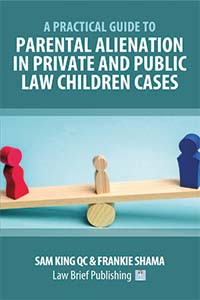
Book review: Practical Guide to Parental Alienation in Private & Public Law Children Cases

96688
"It is both a toolkit and a very good reference guide for practitioners faced with cases which have the unfortunate element of parental alienation"
  • Author: Sam King KC and Frankie Shama
  • Publisher: Law Brief Publishing
  • ISBN: 9781913715182
  • RRP: £79.99

This is a welcome addition to the developing literary catalogue dealing with parental alienation. It has the advantage of being modestly short—concise but appropriately so. The authors are barristers at 4 Paper Buildings and have a fine history of handling parental alienation cases. It is both a toolkit and a very good reference guide for practitioners faced with cases which have the unfortunate element of parental alienation. It is also written in a style that many clients themselves could usefully follow.

There are chapters dealing with the legal and psychiatric definition of parental alienation. A particularly good chapter considers the broad principles regarding child arrangements in Children Act 1989 proceedings generally, which includes an excellent

If you are not a subscriber, subscribe now to read this content
If you are already a subscriber sign in
...or Register for two weeks' free access to subscriber content

MOVERS & SHAKERS

Thomson Hayton Winkley—Jordan Wallace

Thomson Hayton Winkley—Jordan Wallace

Thomson Hayton Winkley strengthens family law team

Ward Hadaway—Barnaby Rosenthall

Ward Hadaway—Barnaby Rosenthall

Construction lawyer returns to Ward Hadaway in Teesside role

Bird & Bird—Shahin Baghaei

Bird & Bird—Shahin Baghaei

Bird Bird hires leading legal transformation expert

NEWS
Legal aid deserts leave almost one in four without adequate access to justice
The Solicitors Regulation Authority (SRA) has warned solicitors and law firms that using artificial intelligence does not alter their professional obligations, amid concerns over inaccurate legal material and client confidentiality
From forgotten interest claims to case-management appeals, a string of procedural developments offers useful—and occasionally cautionary—lessons for practitioners

Jonathan Fisher KC highlights that it now accounts for around 40% of criminal offences, with roughly 70% involving technology, and argues that the UK cannot simply prosecute its way out of the problem. Detection, investigation and prosecution all require improvement, while different fraud types demand tailored responses.

How forcefully can a litigant criticise a public authority before robust advocacy crosses the line into unreasonable conduct? 
back-to-top-scroll