header-logo header-logo

Crisis? What crisis?

28 March 2019 / David Greene
Issue: 7834 / Categories: Opinion , Brexit , Constitutional law
printer mail-detail

David Greene lays out the (possible) next steps for Brexit, democracy & the country


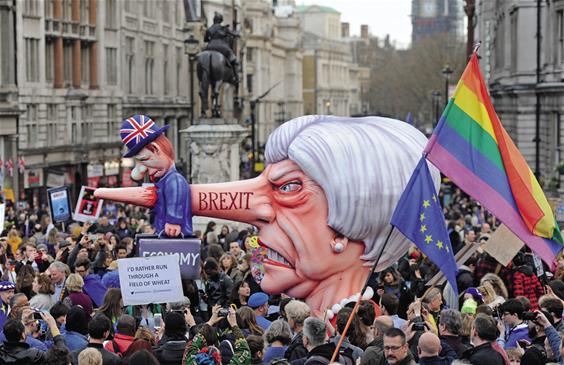
We are, no doubt, in a political crisis. One doesn’t need to have taken sides in the debate to conclude to that effect. This process, which has taken a fresh step of indicative votes, has put under the microscope the relationship between the executive and Parliament, having earlier examined the relationship between the government and the judiciary in the Article 50 litigation. The Westminster model which has replicas in many countries, even down to the physical construction of the debating chamber, has broken down. Does it remain fit for purpose?

The UK version of the Westminster model of governance and democracy retains at its heart the foundation stone of elections based on first past the post. This, its advocates say, produces strong governments based on party politics that are in the position to put into effect their manifesto. With a good majority the government can push through its legislative programme as promised to the electorate. It is more difficult when

If you are not a subscriber, subscribe now to read this content
If you are already a subscriber sign in
...or Register for two weeks' free access to subscriber content

MOVERS & SHAKERS

Pillsbury—Peter O’Hare

Pillsbury—Peter O’Hare

Partner hire bolstersprivate capital and global aviation finance offering

Morae—Carla Mendy

Morae—Carla Mendy

Digital and business solutions firm appoints chief operating officer

Twenty Essex—Clementine Makower & Stephen Du

Twenty Essex—Clementine Makower & Stephen Du

Set welcomes two experienced juniors as new tenants

NEWS
The High Court’s decision in Mazur v Charles Russell Speechlys has thrown the careers of experienced CILEX litigators into jeopardy, warns Fred Philpott of Gough Square Chambers in NLJ this week
Sir Brian Leveson’s claim that there is ‘no right to jury trial’ erects a constitutional straw man, argues Professor Graham Zellick KC in NLJ this week. He argues that Leveson dismantles a position almost no-one truly holds, and thereby obscures the deeper issue: the jury’s place within the UK’s constitutional tradition
Why have private prosecutions surged despite limited data? Niall Hearty of Rahman Ravelli explores their rise in this week's NLJ 
The public law team at Herbert Smith Freehills Kramer surveys significant recent human rights and judicial review rulings in this week's NLJ
In this week's NLJ, Mary Young of Kingsley Napley examines how debarring orders, while attractive to claimants seeking swift resolution, can complicate trials—most notably in fraud cases requiring ‘particularly cogent’ proof
back-to-top-scroll