header-logo header-logo

22 June 2018 / Sir Geoffrey Bindman KC
Issue: 7798 / Categories: Features , Profession
printer mail-detail

Matrimonial intrigue

nlj_7798_bindman

Geoffrey Bindman QC unravels the curious case of the Duchess of Kingston

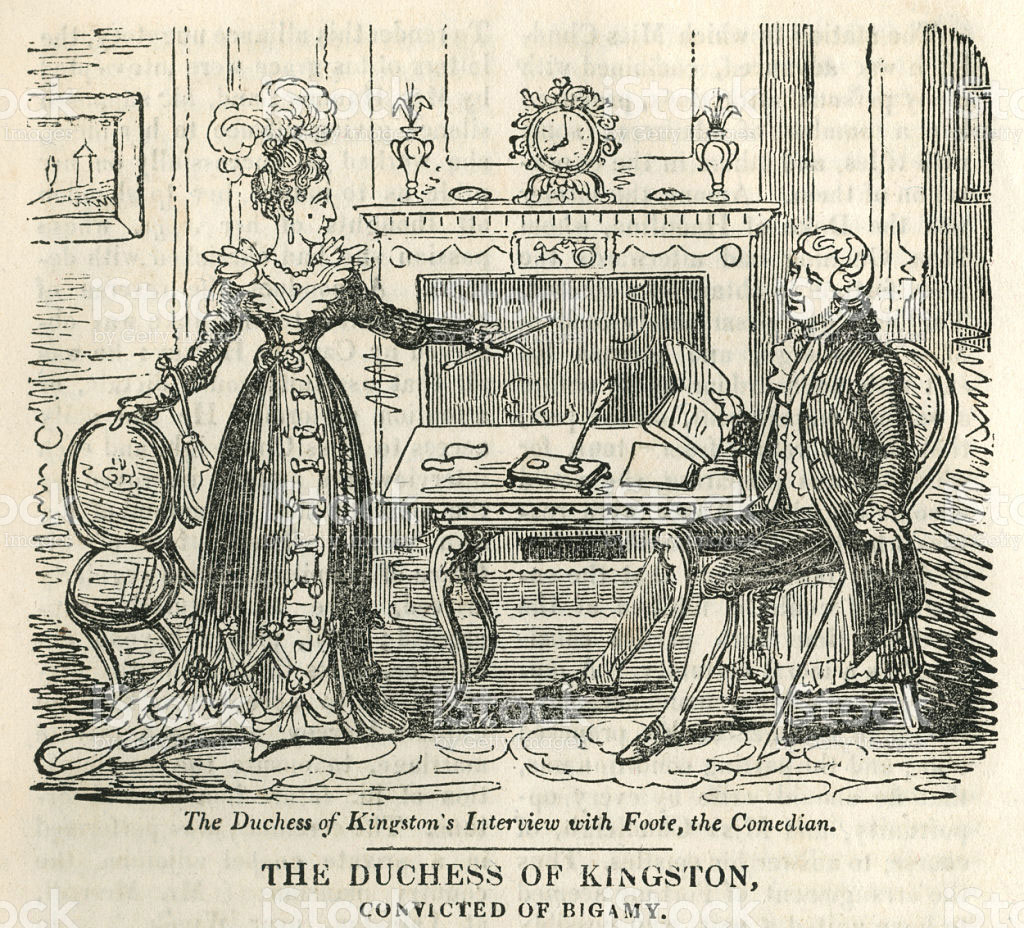
Elizabeth Chudleigh was the Christine Keeler of the 18th century, though rather more successful in her chosen way of life. By force of personality and physical attraction, she rose from a modest background to prominence in the court of King George III, marrying the heir to an earl and later the Duke of Kingston. She is best remembered today, however, for being convicted of bigamy by the House of Lords in 1786.

A secret marriage

Her story throws some light on the law relating to marriage and the status of women in those days. She secured a salaried position in the court as maid of honour to the Princess of Wales. Born in 1720, she met and in 1744 married Augustus Hervey, a naval officer who later inherited the title of Earl of Bristol. The marriage ceremony was performed in a private chapel at the home of her aunt and kept secret in order to enable her to keep her job,

If you are not a subscriber, subscribe now to read this content
If you are already a subscriber sign in
...or Register for two weeks' free access to subscriber content

MOVERS & SHAKERS

Gateley Legal—Caroline Pope & Bob Maynard

Gateley Legal—Caroline Pope & Bob Maynard

Construction team bolstered by hire of senior consultant duo

Switalskis—four appointments

Switalskis—four appointments

Firm expands residential conveyancing team with quadruple appointment

mfg Solicitors—Claire Pope

mfg Solicitors—Claire Pope

Private client team welcomes senior associatein Worcester

NEWS
What safeguards apply when trust corporations are appointed as deputy by the Court of Protection? 
Disputing parties are expected to take part in alternative dispute resolution (ADR), where this is suitable for their case. At what point, however, does refusing to participate cross the threshold of ‘unreasonable’ and attract adverse costs consequences?
When it comes to free legal advice, demand massively outweighs supply. 'Millions of people are excluded from access to justice as they don’t have anywhere to turn for free advice—or don’t know that they can ask for help,' Bhavini Bhatt, development director at the Access to Justice Foundation, writes in this week's NLJ
When an ex-couple is deciding who gets what in the divorce or civil partnership dissolution, when is it appropriate for a third party to intervene? David Burrows, NLJ columnist and solicitor advocate, considers this thorny issue in this week’s NLJ
NLJ's latest Charities Appeals Supplement has been published in this week’s issue
back-to-top-scroll