


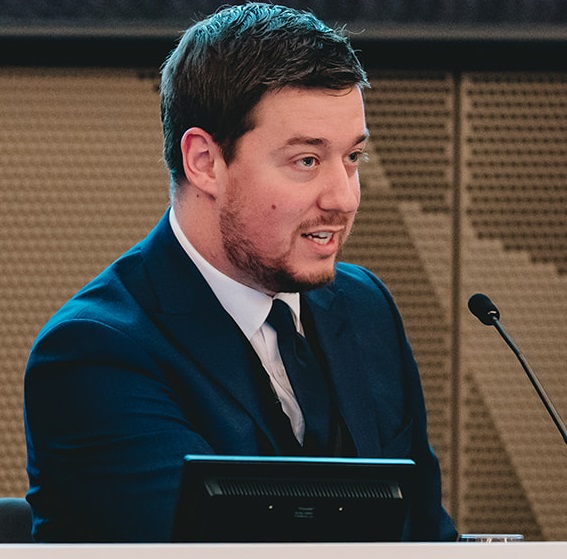
Jack Ridgway, the new chair of the Association of Costs Lawyers, discusses his alternate career as a draughtsman & how a dinosaur bagged him his first role…
What was your route into the profession?
I stumbled across costs quite by accident. I’d read law at university and knew that I wanted to work in the legal industry, but I’d decided that I didn’t want to double my university debt by taking the LPC (Legal Practice Course) without a sponsor firm. Therefore, I was looking for my first role in the legal world and came across an advert for a Costs Draftsman only ten minutes away from home. I can’t say that I understood how interesting, challenging, or rewarding, a career in costs would be; I knew it was preferable to being jobless and having an empty bank account.
I will always remember my first interview, where I was asked—in all seriousness—'what was my favourite dinosaur?’ After some hesitation, I answered ‘Triceratops’—it must have been an acceptable answer, as I was offered the job. From there, I cut my teeth costing fast-track RTA claims before moving to the firm’s London office and onto a more varied and complex caseload. It has been onwards and upwards ever since.
What has been your biggest career challenge so far?
There have been a few, but the case of Yirenkyi v Ministry of Defence [2019] EWHC 1955 (QB) stands out. The hearing was for a payment on account of costs following acceptance of a Part 36 offer, the real issue between the parties was whether the paying party had received enough information and what sum was reasonable. Both my opponent and I gave copies of Finnegan v Spiers [2018] EWHC 3064 [2018] 6 Costs LO 729 (now overturned) to the judge, which said there was no jurisdiction for the judge to order a payment on account.
Being given five minutes to read the case, to anticipate the defendant's arguments, and develop my own, was a real challenge. Attempting to convince a High Court judge that the judgment of his learned friend was plainly wrong and should be disregarded was a genuine do or die moment.
Which person within the legal profession inspires you most?
I’ve been fortunate to have been inspired by more people than I can name—nor could I pick a single favourite. I’ve been fortunate to have learned from some fantastic managers and mentors, Joanne Powell, Lewis Thompson, and Sam Hayman have all had real impact on my development and inspired me to push myself to become a better lawyer.
If you weren’t a lawyer, what would you choose as an alternate career?
I always find this question fascinating; the road not taken. I’ve always enjoyed making things and working as part of a team—I can make my way through flat pack instructions with a speed that my wife finds dizzying. So, if I’d not found my calling in law, then I think I would probably have gone into engineering where I may have started off as a draughtsman.
Who is your favourite fictional lawyer?
My favourite fictional lawyer is Jack McCoy, the District Attorney in Law and Order. During my teenage years, it was impossible to be in my house not see either CSI or Law and Order on the TV. A lawyer who was willing to push the rules in pursuit of the bad guys and who always faced setbacks with renewed determination; practical when necessary but always pursuing justice for the victims.
What change would you make to the profession?
Recognition. Costs Lawyers are a relatively small cohort, and a lot of our fellow legal professionals still do not know, or realise, the difference between a Costs Lawyer and a Costs Draftsman. The three years training, assignments and exams, continuing professional development, and professional requirements set Costs Lawyers apart from unqualified Costs Draftsman. Imagine the rebuke if I called a Solicitor a Paralegal…
How do you relax?
I like working on practical tasks so I can be regularly found putting together furniture or painting. I also enjoy a good hike through the Kent countryside and further afield or reading a good sci-fi book.
Jack Ridgway is chair of the Association of Costs Lawyers and Associate Costs Lawyer at Bolt Burdon Kemp.


