header-logo header-logo

NLJ this week: Leaving the Convention?

11 December 2020
Issue: 7914 / Categories: Legal News , EU , Human rights , Brexit
printer mail-detail
34118
The government sparked controversy this week by announcing a review of the Human Rights Act 1998. 

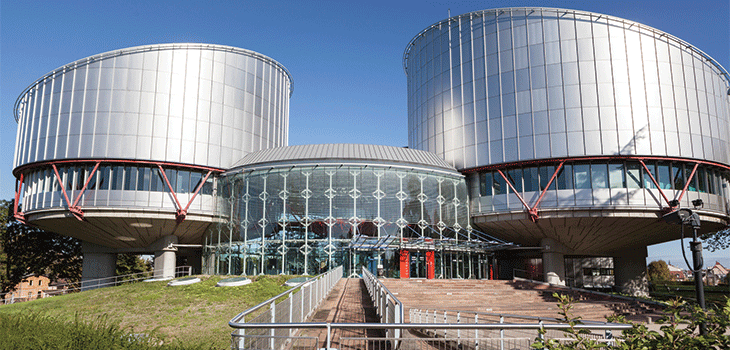
Quick off the mark, barrister Alec Samuels makes the case in NLJ this week for the UK to leave the European Convention on Human Rights (something the government has said it has no intention of doing―the review panel will look at the application of the rights in domestic law).

Samuels casts a critical eye over the current framework of rights, and suggests that ‘in many situations the apparent protections may in fact even be illusory’.

MOVERS & SHAKERS

Carey Olsen—Kim Paiva

Carey Olsen—Kim Paiva

Group partner joins Guernsey banking and finance practice

Morgan Lewis—Kat Gibson

Morgan Lewis—Kat Gibson

London labour and employment team announces partner hire

Foot Anstey McKees—Chris Milligan & Michael Kelly

Foot Anstey McKees—Chris Milligan & Michael Kelly

Double partner appointment marks Belfast expansion

NEWS
The Ministry of Justice (MoJ) has not done enough to protect the future sustainability of the legal aid market, MPs have warned
Writing in NLJ this week, NLJ columnist Dominic Regan surveys a landscape marked by leapfrog appeals, costs skirmishes and notable retirements. With an appeal in Mazur due to be heard next month, Regan notes that uncertainties remain over who will intervene, and hopes for the involvement of the Lady Chief Justice and the Master of the Rolls in deciding the all-important outcome
After the Southport murders and the misinformation that followed, contempt of court law has come under intense scrutiny. In this week's NLJ, Lawrence McNamara and Lauren Schaefer of the Law Commission unpack proposals aimed at restoring clarity without sacrificing fair trial rights
The latest Home Office figures confirm that stop and search remains both controversial and diminished. Writing in NLJ this week, Neil Parpworth of De Montfort University analyses data showing historically low use of s 1 PACE powers, with drugs searches dominating what remains
Boris Johnson’s 2019 attempt to shut down Parliament remains a constitutional cautionary tale. The move, framed as a routine exercise of the royal prerogative, was in truth an extraordinary effort to sideline Parliament at the height of the Brexit crisis. Writing in NLJ this week, Professor Graham Zellick KC dissects how prorogation was wrongly assumed to be beyond judicial scrutiny, only for the Supreme Court to intervene unanimously
back-to-top-scroll