header-logo header-logo

13 May 2022
Issue: 7978 / Categories: Legal News , Criminal
printer mail-detail

NLJ this week: Own goals, ping-pong and finally passed―the Police, Crime Sentencing and Courts Act 2022

81380
A dizzying number of amendments―161 in total―including some made by the government to its own Bill and some energetic Parliamentary ping-pong between the Commons and Lords marked the 13-month journey of the controversial Police, Crime Sentencing and Courts Act

But what exactly is in it? And what was thrown out along the way? LSE Professor Michael Zander looks at both the Bill’s content and its troubled passage into law, in this week’s NLJ.

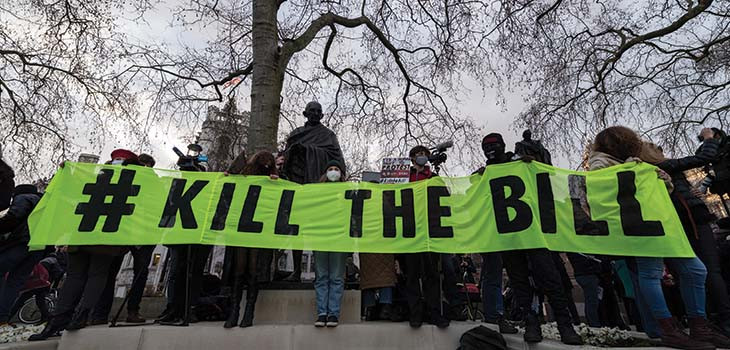
The curbs on protest, ‘triggered by extreme Extinction Rebellion protests’, attracted outrage. Zander also notes the inclusion of a new offence of recording images of breast-feeding without consent, a change to the time limit on common assault and battery, and the grant of PACE powers of investigation to Food Standards Agency officers.

MOVERS & SHAKERS

Freeths—Rachel Crosier

Freeths—Rachel Crosier

Projects and rail practices strengthened by director hire in London

DWF—Stephen Hickling

DWF—Stephen Hickling

Real estate team in Birmingham welcomes back returning partner

Ward Hadaway—44 appointments

Ward Hadaway—44 appointments

Firm invests in national growth with 44 appointments across five offices

NEWS
The Police and Criminal Evidence Act 1984 transformed criminal justice. Writing in NLJ this week, Ed Cape of UWE and Matthew Hardcastle and Sandra Paul of Kingsley Napley trace its ‘seismic impact’
Operational resilience is no longer optional. Writing in NLJ this week, Emma Radmore and Michael Lewis of Womble Bond Dickinson explain how UK regulators expect firms to identify ‘important business services’ that could cause ‘intolerable levels of harm’ if disrupted
Criminal juries may be convicting—or acquitting—on a misunderstanding. Writing in NLJ this week Paul McKeown, Adrian Keane and Sally Stares of The City Law School and LSE report troubling survey findings on the meaning of ‘sure’
The Serious Fraud Office (SFO) has narrowly preserved a key weapon in its anti-corruption arsenal. In this week's NLJ, Jonathan Fisher KC of Red Lion Chambers examines Guralp Systems Ltd v SFO, in which the High Court ruled that a deferred prosecution agreement (DPA) remained in force despite the company’s failure to disgorge £2m by the stated deadline
As the drip-feed of Epstein disclosures fuels ‘collateral damage’, the rush to cry misconduct in public office may be premature. Writing in NLJ this week, David Locke of Hill Dickinson warns that the offence is no catch-all for political embarrassment. It demands a ‘grave departure’ from proper standards, an ‘abuse of the public’s trust’ and conduct ‘sufficiently serious to warrant criminal punishment’
back-to-top-scroll