


The risk and compliance headaches facing many firms, particularly but not exclusively those who deal with Russia, have Russian clients, or have offices in Russia, have increased exponentially since the invasion of Ukraine and at such a pace that it is barely possible to pen an article without knowing it will be out of date before reaching the end.
The impact of international sanctions on the streets of Moscow is already manifesting itself as many global franchises have disappeared from GUM, the signature fashion department store, and memes are circulating in Russia such as ‘The Devil no longer wears Prada, the devil also no longer wears H&M, now the devil will wear Belarussian knitwear’. While the reasons cited are social, economic and governance related, the restrictions on banking and card payments must have played their part.
Wide scope of sanctions
Sanctions can affect any law firm―some years ago the writer encountered a small personal injury firm which found it had a client on a sanctions list. The breadth of scope of the sanctions now being imposed, even prohibiting the sale of tickets to Chelsea Football Club matches, is such that many firms who do not regard themselves as being in the vanguard of firms acting for Russians may find themselves caught up unwittingly.
The £20.47m fine on Standard Chartered Bank imposed by the Office of Financial Sanctions Implementation (OFSI), reduced after ministerial review, in relation to loans to a Turkish bank and subsidiary of a Russian entity illustrates the point, albeit pre-dating the Russian invasion of Ukraine. Few details of Standard Chartered’s conduct were published, but it appears to have identified sanctions concerns regarding the loans, but then analysed the issues incorrectly, before later changing its mind and self-reporting to OFSI.
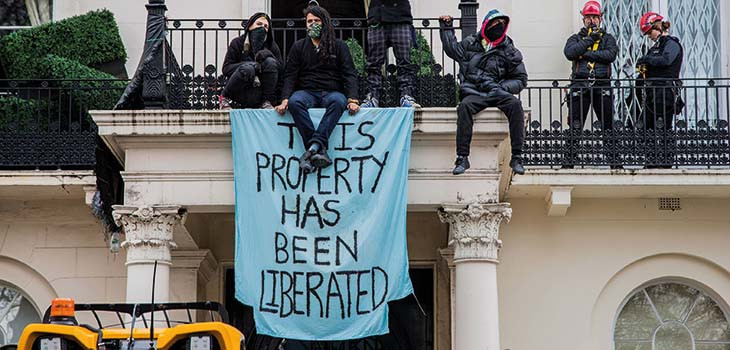
The case is also a potential indicator of concerns for the property sector, as property may be held through a complex web of structures in multiple jurisdictions, many offshore and shrouded in secrecy. The Times reported on 5 March 2022 that of nearly 7,000 UK companies owned by Russian nationals, many are either owned or controlled by the Russian state.
Sanctions are now impacting more sectors, including aviation, shipping and insurance. The Civil Aviation Authority has power to detain aircraft suspected of having links with Russia and Russian aircraft are banned from UK airspace; The Times reported that senior aviation sources predicted this could include up to 50 aircraft already on British tarmac. Ships owned or chartered by Russians are banned from entering UK ports.
Sanctions prevent firms from receiving payment from or making funds available to persons on the sanctions list, dealing with their economic resources, or making otherwise legitimate payments to them. Undertaking legal work for a sanctioned person without a licence from OFSI would be a breach. The Russia (Sanctions) (EU Exit) (Amendment) Regulations 2022 widen the designation criteria, particularly in relation to persons ‘involved in destabilising Ukraine or undermining or threatening the territorial integrity, sovereignty or independence of Ukraine’.
Moskva na Temze
The exodus of international firms from Moscow still leaves problems in London, aka Londongrad or Moskva na Temze, and for firms with an international footprint, as it appears that wealthy Russians may now be flocking to Dubai in response to the West tightening sanctions. International firms also face the complexities of differing sanctions regimes in different jurisdictions which, for the same entity, may involve different restrictions or permutations of restrictions, including asset freezes, prohibitions on correspondent banking and banking transactions, debt and equity restrictions, and prohibitions on clearing currency.
Ransomware payments were flagged by the US Office of Foreign Assets Control (OFAC) in an ‘Updated Advisory on Potential Sanctions Risks for Facilitating Ransomware Payments’, and in September 2021, OFAC sanctioned a cryptocurrency exchange, SUEX OTC SRO, for facilitating financial transactions for ransomware actors.
However, there may be limitations on the (mis)use of cryptocurrency, as at some point it has to be converted into fiat, and the Russians would need a bank or a broker to do so.
Financial regulators across the world are on the lookout for evasion of sanctions, and the Solicitors Regulation Authority (SRA) updated its warning notice on 4 March 2022, reminding firms that they must have appropriate policies in place to ensure they comply with sanctions legislation, including undertaking regular and appropriate checks of sanctions lists, and has indicated that it will be carrying out spot checks.
Rapid pace of change
Additions to the sanctions list, now almost daily, emphasise the need to ensure that firms clearly understand how often their providers update electronic checks, their data sources and use of filters and fuzzy matching. At the time of writing, the UK has sanctioned 614 individuals, entities and subsidies since the start of the war, and 16 oligarchs with a combined wealth of $50bn have been sanctioned since the invasion. Firms should also subscribe to OFSI email alerts and keep themselves apprised of other updates from OFSI, most recently (at the time of writing), an OFSI blog, ‘Russia: What has changed and what do I need to do?’ (See: bit.ly/3CDU9bA) The Law Society has also published a guide to the UK sanctions regime (see: bit.ly/3JaMBPX).
We have what may even be the fastest moving area of legal development the world has ever known, and it is little wonder that compliance teams are feeling the strain. And yet simply deciding not to act for Russians is not without issues either, including the rule of law and the right to representation, and restrictions on a lawyer’s right to terminate retainers.
Frank Maher is a partner in Legal Risk LLP, solicitors specialising in professional regulation and professional indemnity (www.legalrisk.co.uk).


