header-logo header-logo

The hydra grows another head

07 November 2025 / Sailesh Mehta , Theo Burges
Issue: 8138 / Categories: Features , Criminal , National security , Media , Data protection , Privacy
printer mail-detail
235046
The Afghan leak super-injunction highlights the growing body of national security law spanning ever-increasing areas of practice, write Sailesh Mehta & Theo Burges
  • The increasing volume of national security cases and legal matters involving national security reflects heightened global and domestic concerns.
  • The diverse nature of national security work means a wide range of responsibilities and disciplines are involved, from intelligence and cybersecurity to counterterrorism and enforcement.
  • The evolving national security legal framework is adapting to new threats, technologies and geopolitical shifts.

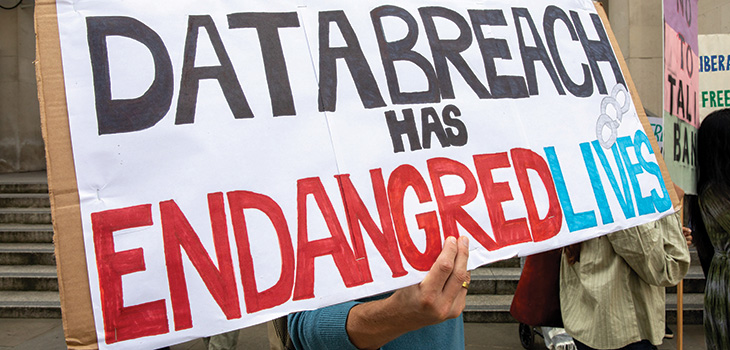
In July of this year, Mr Justice Chamberlain discharged a super-injunction designed to prevent the reporting of a 2022 leak which put the lives of Afghans who co-operated with the UK in Afghanistan and their families at risk. In August, astoundingly, there was a further data breach in relation to British engagement in Afghanistan. The injunction was primarily granted due to concerns regarding threats to the lives of those connected to the leak, but it also later became clear

If you are not a subscriber, subscribe now to read this content
If you are already a subscriber sign in
...or Register for two weeks' free access to subscriber content

MOVERS & SHAKERS

Red Lion Chambers—Maurice MacSweeney

Red Lion Chambers—Maurice MacSweeney

Set creates new client and business development role amid growth

Kingsley Napley—Tim Lowles

Kingsley Napley—Tim Lowles

Sports disputes practice launchedwith partner appointment

mfg Solicitors—Tom Evans

mfg Solicitors—Tom Evans

Tax and succession planning offering expands with returning partner

NEWS
The rank of King’s Counsel (KC) has been awarded to 96 barristers, and no solicitors, in the latest silk round
Neurotechnology is poised to transform contract law—and unsettle it. Writing in NLJ this week, Harry Lambert, barrister at Outer Temple Chambers and founder of the Centre for Neurotechnology & Law, and Dr Michelle Sharpe, barrister at the Victorian Bar, explore how brain–computer interfaces could both prove and undermine consent
Comparators remain the fault line of discrimination law. In this week's NLJ, Anjali Malik, partner at Bellevue Law, and Mukhtiar Singh, barrister at Doughty Street Chambers, review a bumper year of appellate guidance clarifying how tribunals should approach ‘actual’ and ‘evidential’ comparators. A new six-stage framework stresses a simple starting point: identify the treatment first
In cross-border divorces, domicile can decide everything. In NLJ this week, Jennifer Headon, legal director and head of international family, Isobel Inkley, solicitor, and Fiona Collins, trainee solicitor, all at Birketts LLP, unpack a Court of Appeal ruling that re-centres nuance in jurisdiction disputes. The court held that once a domicile of choice is established, the burden lies on the party asserting its loss
Early determination is no longer a novelty in arbitration. In NLJ this week, Gustavo Moser, arbitration specialist lawyer at Lexis+, charts the global embrace of summary disposal powers, now embedded in the Arbitration Act 1996 and mirrored worldwide. Tribunals may swiftly dismiss claims with ‘no real prospect of succeeding’, but only if fairness is preserved
back-to-top-scroll