


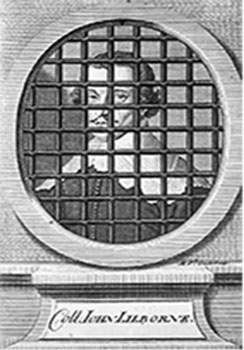
Some years ago The Guardian invited some of us to choose their legal hero. I chose John Lilburne, leader of the Levellers, a radical group formed at the time of the English Civil War in the mid-17th century. He was not a lawyer but made several remarkable contributions to the development of safeguards for defendants in criminal trials. He established the right to silence and argued for the right to legal representation which he was denied on the several occasions when he appeared as a defendant. The most celebrated of these was his trial for treason at the Guildhall in London in October 1649.
This followed his break with Oliver Cromwell, now heading the Government as ‘Lord Protector’ following the execution of King Charles I in January 1649. Two new Treason Acts in May and July of that year extended an offence designed to protect the monarchy to embrace attacks on the new Commonwealth Government. The Levellers campaigned for the adoption of their ‘Agreement of the People’, which contested the authoritarian aims of Cromwell and his ‘Rump’ parliament. Lilburne had distributed pamphlets attacking the new regime. He was its first target.
The charge of High Treason alleged that he ‘maliciously, advisedly, and traitorously didst plot, contrive, and endeavour to stir up and to raise force against the Government’.
A carefully chosen court of five judges was weighted heavily against him but they sat with a jury. Lilburne determined to make the task of the prosecution and the judges as difficult as possible, refusing to admit his authorship of the pamphlets bearing his name, demanding legal representation, continuing to challenge the authority of the court and the government. When refused permission to leave the court to relieve himself he requested a chamber pot. Notoriously, he used it in open court.
He knew that his only hope of escaping execution lay with the jury.
Origins
The origin of the jury in Anglo-Saxon times was in the notion that guilt or innocence was to be determined by the local community from its own knowledge of the facts or, more contentiously, by the application of tests of veracity which today we would dismiss as superstition or fantasy. The divided role of determining fact and law between judges and jury came later.
Lilburne’s judges were at pains to inform him at the outset that the determination of his legal liability was their responsibility, not the jury’s. Lilburne pulled no punches. ‘You that call yourselves judges of the law are no more than Norman intruders and indeed and in truth if the jury please are no more than ciphers.’ The outraged Judge Jermyn replied that ‘this damnable blasphemous heresie’ was ‘enough to destroy all the law in the land’.
What if the jury rejected or ignored the judges’ legal ruling?
In summing up for the prosecution the Solicitor-General, Prideaux, complained that Lilburne had sought by ‘glossing speeches or insinuations, to wind into the affections of the jury, as he cunningly and smoothly hath done, by calling them his fellow citizens and the like’.
If so, it worked. After retiring for only an hour the jury found John Lilburne not guilty of all charges: ‘Immediately the whole multitude of people in the hall, for joy at the prisoner’s acquittal, gave such a loud and unanimous shout as is believed was never heard in Guildhall which lasted for about half an hour without intermission which made the judges for fear turn pale and hang down their heads.’
No attempt was made to challenge the verdict but Lilburne, in fear of reprisals from Cromwell, fled the country to exile in Holland.
In recent years appellate courts have from time to time asserted the right to set aside a jury verdict when persuaded that it was based on serious error, but the jury’s final authority is widely acknowledged. Lilburne’s popularity and the political sensitivities of the time may have discouraged Cromwell from pursuing a legal challenge.
Personal experience
In 1985 I was part of the legal team defending the civil servant Clive Ponting on charges of disclosing official information to an unauthorised person in breach of s 2 of the Official Secrets Act. Ponting acknowledged that he had sent two documents to Tam Dalyell MP—a draft letter and a memorandum revealing important information about an episode in the Falklands war—contrary to the instructions of government ministers. Ponting did not dispute this but his defence was that he did so in the public interest. Argument on whether such a defence was available took place before the trial judge in the absence of the jury. The judge ruled that there was no public interest defence and directed the jury accordingly that they had no choice but to convict.
The jury did not agree. Asserting their power, they acquitted unanimously. Ponting walked free and the prosecution made no appeal. The finality of the jury’s verdict is a vital constitutional safeguard. It has not been mentioned as part of the remit of the government’s proposed constitutional commission, now presumably delayed by the pandemic. The authority of the jury must not be surrendered to judges or governments.
Sir Geoffrey Bindman QC, NLJ columnist & senior consultant, Bindmans LLP.


