header-logo header-logo

24 April 2026 / David Wolchover
Issue: 8158 / Categories: Opinion , Criminal , In Court
printer mail-detail

A hidden factor behind the backlog?

247614
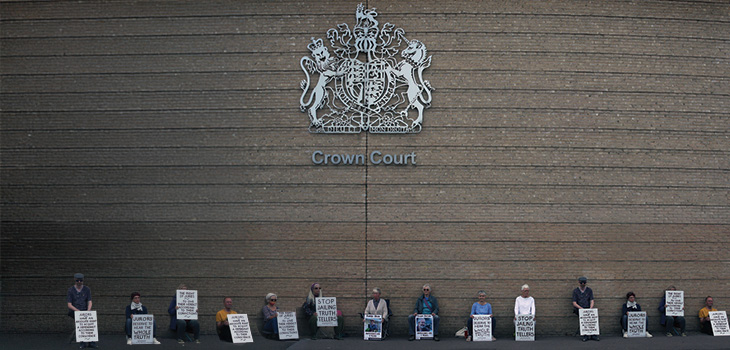
© Martin Pope/ZUMA Press Wire/Shutterstock

Tightening the prosecution test, not curbing jury trials, could stem the flow of weak cases overwhelming the crown court, argues David Wolchover

The Courts and Tribunals Bill was passed by the House of Commons at first reading on 10 March, with only ten Labour members dissenting. However, large numbers abstained, and it is anticipated that, if the government does not relent, they may well see off the proposed ending of jury trial for offences carrying under three years’ imprisonment. The government contends that the measure—recommended in Part 1 of Sir Brian Leveson’s Independent Review of the Criminal Courts—will be a key factor in reducing the Crown Court backlog of cases, now at crisis level.

Critics of the proposal point to chronic under-investment in criminal justice as the cause, but there is a hidden factor at work—one only indirectly related to the use of juries. Quite simply, far too many prosecutions are being permitted to proceed to trial as a result of the institutional inadequacy of the statutory screening process

If you are not a subscriber, subscribe now to read this content
If you are already a subscriber sign in
...or Register for two weeks' free access to subscriber content

MOVERS & SHAKERS

Winckworth Sherwood—Rubianka Winspear

Winckworth Sherwood—Rubianka Winspear

Real estate and construction energy offering boosted by partner hire

Gateley Legal—Daniel Walsh

Gateley Legal—Daniel Walsh

Firm bolsters real estate team with partner hire in Birmingham

Shakespeare Martineau—Serena Eddy

Shakespeare Martineau—Serena Eddy

London restructuring team strengthened by legal director appointment

NEWS
A wave of housing and procedural reforms is set to test the limits of tribunal capacity. In his latest Civil Way column for NLJ this week, Stephen Gold charts sweeping change as the Renters’ Rights Act 2025 begins biting
Plans to reduce jury trials risk missing the real problem in the criminal justice system. Writing in NLJ this week, David Wolchover of Ridgeway Chambers argues the crown court backlog is fuelled not by juries but weak cases slipping through a flawed ‘50%’ prosecution test
Emerging technologies may soon transform how courts determine truth in deeply personal disputes. In this week's NLJ, Madhavi Kabra of 1 Hare Court and Harry Lambert of Outer Temple Chambers explore how neurotechnology could reshape family law
A controversial protest case has reignited debate over the limits of free expression. In NLJ this week, Nicholas Dobson examines a Quran-burning incident testing public order law
The courts have drawn a firm line under attempts to extend arbitration appeals. Writing in NLJ this week, Masood Ahmed of the University of Leicester highlights that if the High Court refuses permission under s 68 of the Arbitration Act 1996, that is the end
back-to-top-scroll