header-logo header-logo

03 April 2026 / Nicholas Dobson
Issue: 8156 / Categories: Features , Public , Judicial review , Human rights
printer mail-detail

A tale of two coppers

246227

Nicholas Dobson examines the vindication of two officers who took action against the Police Federatio

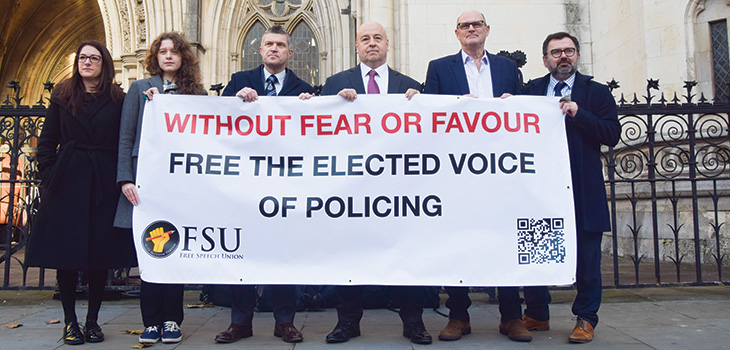
  • In a recent Administrative Court case, the removal from office of two Police Federation branch representatives was found unlawful.
  • The reasons cited in the judgment included ultra vires and disproportionate actions breaching Art 10 of the European Convention on Human Rights.

‘It was the best of times, it was the worst of times….’ So famously opens Dickens’ 1859 novel A Tale of Two Cities, set in London and Paris before and during the French Revolution. The work is scathing both about cruel aristocratic tyranny and consequent revolutionary bloodlust. But while modern UK public bodies have a duty to act fairly in line with the principles of natural justice, Parisian revolutionary tribunals had no such constraints. Dickens remarked: ‘Before that unjust Tribunal, there was little or no order of procedure, ensuring to any accused person any reasonable hearing.’

However, even today, public law rules may be innocently misunderstood and misapplied, leading to unjust

If you are not a subscriber, subscribe now to read this content
If you are already a subscriber sign in
...or Register for two weeks' free access to subscriber content

MOVERS & SHAKERS

NLJ Career Profile: Ling Ong, London Market FOIL

NLJ Career Profile: Ling Ong, London Market FOIL

Ling Ong, partner at Weightmans and president of London Market FOIL, discusses her biggest inspirations, the challenges of AI and the importance of tackling unconscious bias

DWF—Imogen Francis

DWF—Imogen Francis

Director and head of IP team joins in Birmingham

Penningtons Manches Cooper—five promotions

Penningtons Manches Cooper—five promotions

Firm boosts partnership and costs practice with five senior promotions

NEWS

From blockbuster judgments to procedural shake-ups, the courts are busy reshaping litigation practice. Writing in NLJ this week, Professor Dominic Regan of City Law School hails the Court of Appeal's 'exquisite judgment’ in Mazur restoring the role of supervised non-qualified staff, and highlights a ‘mammoth’ damages ruling likened to War and Peace, alongside guidance on medical reporting fees, where a pragmatic 25% uplift was imposed

Momentum is building behind proposals to restrict children’s access to social media—but the legal and practical challenges are formidable. In NLJ this week, Nick Smallwood of Mills & Reeve examines global moves, including Australia’s under-16 ban and the UK's consultation
Reforms designed to rebalance landlord-tenant relations may instead penalise leaseholders themselves. In this week's NLJ, Mike Somekh of The Freehold Collective warns that the Leasehold and Freehold Reform Act 2024 risks creating an ‘underclass’ of resident-controlled freehold companies
Timing is everything—and the Court of Appeal has delivered clarity on when proceedings are ‘brought’. In his latest 'Civil way' column for NLJ, Stephen Gold explains that a claim is issued for limitation purposes when the claim form is delivered to the court, even if fees are underpaid
The traditional ‘single, intensive day’ of financial dispute resolution (FDR) may be due for a rethink. Writing in NLJ this week, Rachel Frost-Smith and Lauren Guiler of Birketts propose a ‘split FDR’ model, separating judicial evaluation from negotiation
back-to-top-scroll