header-logo header-logo

12 August 2020 / Harry Potter
Categories: Features , Constitutional law
printer mail-detail

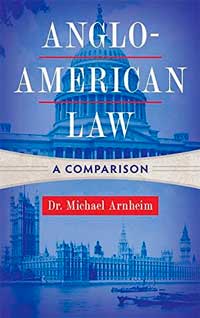
Book review: Anglo-American Law: A Comparison

"As much an argument as a disquisition, and full of amusing asides, it pulls no punches about the danger of judicial activism..."

Author: Michael Arnheim
Publisher: Talbot Publishing
ISBN: 9781616196325
Price: £70 hb, £7.98 ebook

From the author of The US Constitution for Dummies, this book is in similar vein and covers some of the same material. It provides a comparative overview of the legal systems in England and America, accompanied by many analyses of cases mainly relating to torts, privacy and human rights. Criminal law is absent. 

As much an argument as a disquisition, and full of amusing asides, it pulls no punches about the danger of judicial activism which is rife in both jurisdictions. Almost every page is thought-provoking and contentious. The main thesis is that in England, beginning with the case of Donoghue v Stephenson in 1932 (‘the year of the snail’ as Arnheim calls it), legal principle has been increasingly sacrificed to judicial law-making.

The issue of judicial encroachment into the sovereignty of parliament

If you are not a subscriber, subscribe now to read this content
If you are already a subscriber sign in
...or Register for two weeks' free access to subscriber content

MOVERS & SHAKERS

Walkers—Muriel Marseille

Walkers—Muriel Marseille

Ashurst's Chief Risk Officer joins Walkers

Excello Law—John Osborne

Excello Law—John Osborne

Northern family lawyer John Osborne joins Excello

mfg Solicitors—Rebecca Rogers, Kennedy Langley & Victoria Griffiths

mfg Solicitors—Rebecca Rogers, Kennedy Langley & Victoria Griffiths

Trio of promotions announced at Kidderminster law firm mfg Solicitors

NEWS
A sole director can conspire with their own company for the purposes of the tort of unlawful means conspiracy, the High Court has ruled in a judgment with potentially wide implications for business disputes
The Court of Appeal has reinforced that domicile depends on intention rather than residence alone, in a significant post-Brexit ruling on cross-border financial remedy claims
The Chancery Division's long history comes to an end this autumn as it is reborn as the Business and Property Division, prompting questions over whether the shake-up is really necessary
The Financial Conduct Authority (FCA) continues to show that failing to disclose regulatory issues can attract harsher consequences than the original misconduct itself
Rejecting a generous settlement can prove an expensive mistake, as two recent high-profile cases demonstrate
back-to-top-scroll