


"I, for one, had been looking forward to getting the latest edition and have not been disappointed"
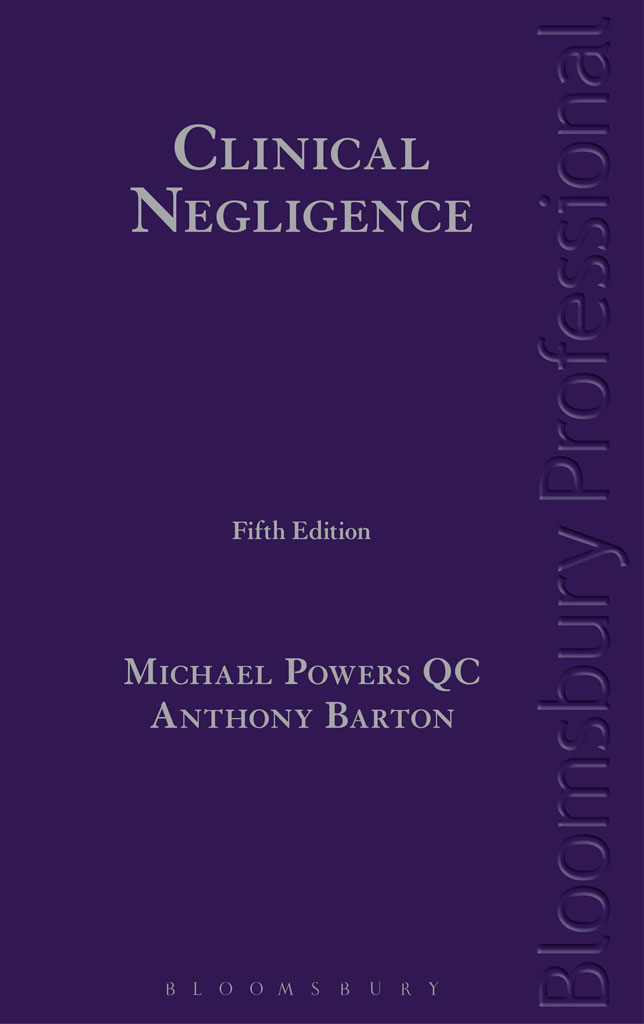
Authors Michael Powers QC & Anthony Barton
Publisher Bloomsbury Professional
ISBN 9781780434858
Price £450
The long awaited 5th Edition of Clinical Negligence (formerly Powers & Harris Clinical Negligence ) has hit our desks. At first glance this is a much slimmer volume than the last edition but it retains its place as a key guide to practitioners in the field.
The introduction highlights that despite the time lapse since the last edition (seven years), the law in the field of clinical negligence hasn’t changed a great deal. Evolution in medicine and treatment and the ever changing world of costs in clinical negligence litigation are the real areas of change over this time. However, it should be noted that the edition is only stated to be reflective of the law to 1 June 2015—and of course there have been further developments since then in both case law and costs law, not least the big concerns about the result of proposed fixed costs on access to justice and patient care standards.
There is some interesting commentary on the proposed Medical Innovation Bill and the real risks that this may present to vulnerable patients. Things have moved on in this respect also and it remains to be seen whether the revised version of the Bill (via Chris Heaton-Harris) which revises the proposed changes to the tests of negligence in such cases goes through and whether the original “Saatchi” Bill is resurrected or falls away.
Some of the procedural chapters previously in the text are no longer—for example the sections on mediation and trial. It will be interesting to see if they resurface in future editions given the courts are starting to impose penalties for failing to engage in alternative dispute resolution and the apparent increased willingness of the NHSLA to run cases to trial.
In terms of the medical chapters, many of the old favourites are there and even some new sections (for example pain management and vascular surgery) but a number haven’t made the cut, including some surprises—for example laparoscopic surgery and infection. This may well have been driven by the substantial number of changes in the contributors since the last edition—of the 55 contributors 36 are new. It may well be that it is lack of experts to contribute that has resulted in the slimmed down version.
Covering the basics—updated
The initial chapters focus on the law and basic principles/procedural requirements of bringing a claim and are a good summary—to include consideration of recent developments such as the impact of Woodland v Swimming Teachers Association [2014] AC 537 on the issue of non-delegable duties and how this applies to the NHS and the introduction of the statutory duty of candour (Health and Social Care Act 2008 (Regulated Activities) Regulations 2014, reg 20). The section on coroners’ inquests is a useful practical guide which addresses the procedure post the Coroners and Justice Act 2009. Writing a costs chapter is a challenge in the current climate where the law develops rapidly but a sensible overview is provided.
For those of us working in the field of product liability, the chapter by the team at Henderson Chambers, well known in this field, is a good overview and guide to some of the complexities of this work.
Medical specialities & associated claims
This remains the best text around to consider as a starting point when assessing whether there may have been a breach of duty in care in a particular field. The chapters range in length from the succinct orthopaedics chapter (16 pages) to the lengthy obstetrics and gynaecology chapter (70 pages). To my mind those chapters which focus on common areas of litigation in the field and what is and is not best practice are the most useful—and I would flag the ED, neurology, ophthalmology, general, vascular and spinal surgery, urology and neonatology chapters as the most useful in these respects. The anaesthesia and endocrinology chapters perhaps give less detail as to what is and is not a failing but provide excellent summaries in terms of the management of certain patients and potential complications and the obstetrics and gynaecology section has some useful tables of common errors in management.
Summary
I, for one, had been looking forward to getting the latest edition and have not been disappointed. There is little in the field of clinical negligence that is not at least touched upon and the text either provides useful guidance (procedural or medical) or at least points in the right direction. Should one have any free time for general reading then some of the chapters provide some excellent information/guidance on a range of topics which can only be useful.
Philippa Luscombe, partner, clinical negligence & personal injury, Penningtons Manches


