header-logo header-logo

31 January 2019 / Patrick Allen
Issue: 7826 / Categories: Features , Legal aid focus
printer mail-detail

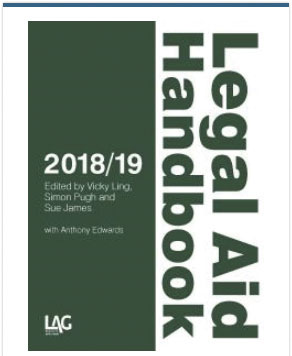
Book review: Legal Aid Handbook 2018/19

  • Editors: Vicky Ling, Simon Pugh & Sue James
  • Publisher: Legal Action Group
  • ISBN: 978-1912273003 
  • Pages: 560
  • RRP: £60

The Legal Aid Handbook is an essential item in the toolkit of any practitioner handling legal aid work. The latest edition is edited by Vicky Ling, Simon Pugh and Sue James, all of whom have extensive legal aid experience (Vicky Ling actually worked for the Legal Aid Board for some years in the 1990s). The handbook covers pretty much everything you would need to know about civil and criminal legal aid, cost claims and the policy framework in one volume.

Given the extensive cutbacks in legal aid scope and funding over the last few years you might think this would be a thin volume, but, of course, this is not the case. The legal aid which remains after the cuts still is bound by complex rules and statutory instruments and practitioners need to find their way through the minefield to conduct any

If you are not a subscriber, subscribe now to read this content
If you are already a subscriber sign in
...or Register for two weeks' free access to subscriber content

MOVERS & SHAKERS

Freeths—Rachel Crosier

Freeths—Rachel Crosier

Projects and rail practices strengthened by director hire in London

DWF—Stephen Hickling

DWF—Stephen Hickling

Real estate team in Birmingham welcomes back returning partner

Ward Hadaway—44 appointments

Ward Hadaway—44 appointments

Firm invests in national growth with 44 appointments across five offices

NEWS
Refusing ADR is risky—but not always fatal. Writing in NLJ this week, Masood Ahmed and Sanjay Dave Singh of the University of Leicester analyse Assensus Ltd v Wirsol Energy Ltd: despite repeated invitations to mediate, the defendant stood firm, made a £100,000 Part 36 offer and was ultimately ‘wholly vindicated’ at trial
The Police and Criminal Evidence Act 1984 transformed criminal justice. Writing in NLJ this week, Ed Cape of UWE and Matthew Hardcastle and Sandra Paul of Kingsley Napley trace its ‘seismic impact’
Operational resilience is no longer optional. Writing in NLJ this week, Emma Radmore and Michael Lewis of Womble Bond Dickinson explain how UK regulators expect firms to identify ‘important business services’ that could cause ‘intolerable levels of harm’ if disrupted
Criminal juries may be convicting—or acquitting—on a misunderstanding. Writing in NLJ this week Paul McKeown, Adrian Keane and Sally Stares of The City Law School and LSE report troubling survey findings on the meaning of ‘sure’
The Serious Fraud Office (SFO) has narrowly preserved a key weapon in its anti-corruption arsenal. In this week's NLJ, Jonathan Fisher KC of Red Lion Chambers examines Guralp Systems Ltd v SFO, in which the High Court ruled that a deferred prosecution agreement (DPA) remained in force despite the company’s failure to disgorge £2m by the stated deadline
back-to-top-scroll