header-logo header-logo

16 June 2021 / Dominic Regan
Categories: Features , Profession
printer mail-detail

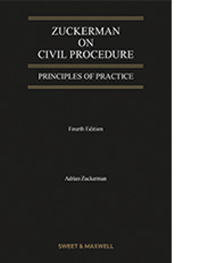
Book review: Zuckerman on Civil Procedure: Principles of Practice (4th Edition)

Author: Professor Adrian Zuckerman

Publisher: Sweet & Maxwell

ISBN: 9780414078420

RRP: £250.00


Long overdue is the new edition of this unique work. Arrival of the last edition coincided with the implementation of the Jackson reforms back in 2013. So much has happened since, not least because of those reforms.

For the first time, the eponymous author has brought talent in to share the burden of updating 1,600 pages of text. What he performed singlehandedly over the first three editions has necessitated the acquisition of both a general editor and ten contributors.

Practitioners are obviously familiar with the major commentaries upon the Civil Procedure Rules, affectionately referred to by the hue of their covers. Those tomes tell us what the rules are and how they have been interpreted. Zuckerman describes the provisions, but then has no compunction in subjecting them to criticisms which one day might just provoke rule change or cause the judiciary to reconsider existing authorities. There is no work in the field

If you are not a subscriber, subscribe now to read this content
If you are already a subscriber sign in
...or Register for two weeks' free access to subscriber content

MOVERS & SHAKERS

Seddons GSC—Ben Marks

Seddons GSC—Ben Marks

Partner joins residential real estate team

Winckworth Sherwood—Shazia Bashir

Winckworth Sherwood—Shazia Bashir

Social housing team announces partner appointment

University of Manchester: The LLM driving tech-focused career growth

University of Manchester: The LLM driving tech-focused career growth

Manchester’s online LLM has accelerated career progression for its graduates

NEWS
The Police and Criminal Evidence Act 1984 transformed criminal justice. Writing in NLJ this week, Ed Cape of UWE and Matthew Hardcastle and Sandra Paul of Kingsley Napley trace its ‘seismic impact’
Operational resilience is no longer optional. Writing in NLJ this week, Emma Radmore and Michael Lewis of Womble Bond Dickinson explain how UK regulators expect firms to identify ‘important business services’ that could cause ‘intolerable levels of harm’ if disrupted
Criminal juries may be convicting—or acquitting—on a misunderstanding. Writing in NLJ this week Paul McKeown, Adrian Keane and Sally Stares of The City Law School and LSE report troubling survey findings on the meaning of ‘sure’
The Serious Fraud Office (SFO) has narrowly preserved a key weapon in its anti-corruption arsenal. In this week's NLJ, Jonathan Fisher KC of Red Lion Chambers examines Guralp Systems Ltd v SFO, in which the High Court ruled that a deferred prosecution agreement (DPA) remained in force despite the company’s failure to disgorge £2m by the stated deadline
As the drip-feed of Epstein disclosures fuels ‘collateral damage’, the rush to cry misconduct in public office may be premature. Writing in NLJ this week, David Locke of Hill Dickinson warns that the offence is no catch-all for political embarrassment. It demands a ‘grave departure’ from proper standards, an ‘abuse of the public’s trust’ and conduct ‘sufficiently serious to warrant criminal punishment’
back-to-top-scroll