header-logo header-logo

05 May 2023 / Neil Parpworth
Issue: 8023 / Categories: Features , Public
printer mail-detail

Fly-tipping: down in the dumps

120989
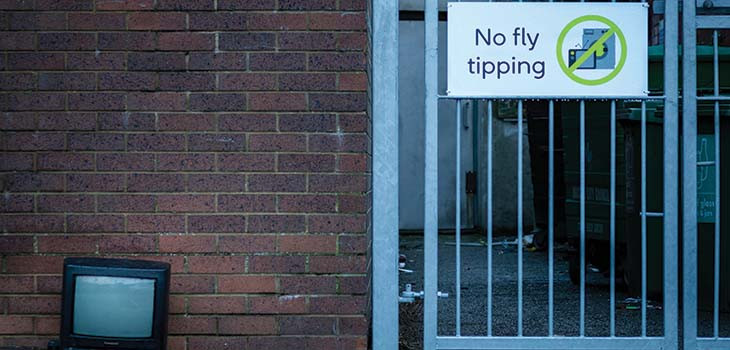
Are government plans for enforcement on fly-tipping likely to have an impact? Neil Parpworth examines the scale of the fly-tipping plague
  • The scale and extent of fly-tipping in England.
  • How it is currently dealt with by local authorities.
  • Whether the government’s proposals are likely to have a positive impact on the problem.

Despite the fact that the term ‘fly-tipping’ is commonly used in everyday language, it does not appear on the statute book, and neither is it referred to in delegated legislation. According to a specialist dictionary, it amounts to ‘the illegal depositing or disposal of waste in an unauthorised manner and location’ (The Concise Lexicon of Environmental Terms). It is thus an offence to fly-tip contrary to s 33(1)(a) of the Environmental Protection Act 1990 (EPA 1990). It should be noted that an associated offence occurs where controlled waste is deposited from a motor vehicle over which the defendant has control: see s 33(5), EPA 1990.

Since those who fly-tip clearly act in an anti-social

If you are not a subscriber, subscribe now to read this content
If you are already a subscriber sign in
...or Register for two weeks' free access to subscriber content

MOVERS & SHAKERS

Freeths—Rachel Crosier

Freeths—Rachel Crosier

Projects and rail practices strengthened by director hire in London

DWF—Stephen Hickling

DWF—Stephen Hickling

Real estate team in Birmingham welcomes back returning partner

Ward Hadaway—44 appointments

Ward Hadaway—44 appointments

Firm invests in national growth with 44 appointments across five offices

NEWS
Criminal juries may be convicting—or acquitting—on a misunderstanding. Writing in NLJ this week Paul McKeown, Adrian Keane and Sally Stares of The City Law School and LSE report troubling survey findings on the meaning of ‘sure’
The Serious Fraud Office (SFO) has narrowly preserved a key weapon in its anti-corruption arsenal. In this week's NLJ, Jonathan Fisher KC of Red Lion Chambers examines Guralp Systems Ltd v SFO, in which the High Court ruled that a deferred prosecution agreement (DPA) remained in force despite the company’s failure to disgorge £2m by the stated deadline
As the drip-feed of Epstein disclosures fuels ‘collateral damage’, the rush to cry misconduct in public office may be premature. Writing in NLJ this week, David Locke of Hill Dickinson warns that the offence is no catch-all for political embarrassment. It demands a ‘grave departure’ from proper standards, an ‘abuse of the public’s trust’ and conduct ‘sufficiently serious to warrant criminal punishment’
Employment law is shifting at the margins. In his latest Employment Law Brief for NLJ this week, Ian Smith of Norwich Law School examines a Court of Appeal ruling confirming that volunteers are not a special legal species and may qualify as ‘workers’
Refusing ADR is risky—but not always fatal. Writing in NLJ this week, Masood Ahmed and Sanjay Dave Singh of the University of Leicester analyse Assensus Ltd v Wirsol Energy Ltd: despite repeated invitations to mediate, the defendant stood firm, made a £100,000 Part 36 offer and was ultimately ‘wholly vindicated’ at trial
back-to-top-scroll