


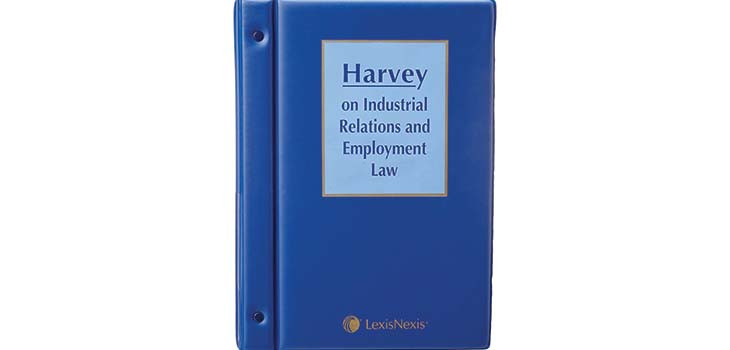
As chance would have it, 2022 marks the 50th anniversary of Harvey on Industrial Relations and Employment Law, the practitioners’ bible on employment law. Its genesis was in the Heath government’s Industrial Relations Act 1971 (never referred to now without the sobriquet ‘ill-fated’) which sought to revolutionise employment and industrial relations law. Harvey started life as a commentary on this Act, the name coming from its original author, RJS (Don) Harvey, an urbane Irishman whose career started at Trinity College, Dublin but who transferred to the English Bar in 1947. He took silk in 1970 and became a Bencher of his Inn in 1980. He sadly died young, in his prime in 1986. However, by that time he had laid the foundations for the current work, which he liked to refer to mischievously (in and out of court) as ‘my little book’. It was indeed originally a book, but soon took on loose-leaf status in order to be kept up to date. When the succeeding Labour government repealed the Act, the work became a more general one on employment law as it then developed. It underwent considerable development with new editors, and took on its present title.
For many years it was written by a small team, or gang of five: Patrick Elias (later Elias LJ), Brian Napier (subsequently the leading Scottish employment law advocate), Chris Osman (head of employment at Clifford Chance) and Andrew Thompson (who for 40 years contributed the key division on practice and procedure), all under the crucial and inspired leadership of Bryn Perrins of Birmingham University’s law faculty—the general editor through so many of its important developments and an authority on the law of industrial action. I joined the team in 1984, initially to write the annotations to the statutes and statutory instruments and contribute the monthly bulletin. This was quite a challenge at the time, given that for my first ten years we had an Employment Bill almost every year, and this was all before the advent of the internet. Indeed, one of Don Harvey’s guiding principles was that the work should be so comprehensive and up-to-date that it could be used with confidence by ‘the Truro solicitor’ without access to other source materials. The hard copy version, now in six volumes, would now need a pick-up truck to carry to a tribunal, though of course the predominant usage now is online: a development over many years that the editors have had to adapt to in the way that the work is written and accessed.
However, through all of these developments, what has remained constant is the function of the work, namely to be an authoritative work of mature and considered analysis of the existing law and the (many) areas of continuing debate and controversy in this most volatile of legal subjects.
One peculiarity of the work is the way it is used in litigation—not only is it used and quoted to tribunals and courts, but it is quoted by them in judgments. The common law tradition has been for such works not to be cited even if used. Moreover, the other tradition here is that a legal writer can only be cited as an authority if dead—a rather extreme way to have your work appreciated. However, it has been noticeable over many years now how often judgments refer specifically to passages in this work: ‘As Harvey states ...’; ‘The argument in Harvey is that ...’. Indeed, in one case in the Court of Appeal a couple of years ago one Lord Justice (an employment law specialist) criticised one of the advocates for not citing all the relevant case law on the point, saying that ‘It could easily have been found in Harvey at paragraph...’. All of this of course adds to the editors’ responsibility to be both comprehensive in coverage and accurate in analysis. The editorial function is particularly important in the internet age in a subject with such a constant stream of website-reported cases, sorting out the legally important cases from the merely interesting or illustrative. Without this, we would now be in at least 12 volumes.
Citation in court can work both ways. One of my favourite Harvey tales concerns one of our editors appearing before the then president of the Employment Appeal Tribunal (EAT), arguing a point directly contrary to what Harvey suggested. The president knew of his editorship and, having theatrically consulted the relevant passage, said: ‘But Mr X, that’s not what Harvey says, is it?’, to which our editor replied: ‘It will be in the next issue’. There is no point having power if you don’t abuse it. Another example was when one of our editors was appointed an EAT judge and she remarked that she was looking forward to the first time she could criticise one of her own judgments.
Where does the work stand now? Partly as a function of the inexorable increase in the subject itself, instead of a gang of six, we now have an editorial team of approximately 20, with more of a balance of barristers and solicitors and more of a gender balance. All of this makes it even more impressive that the issues come out like clockwork to provide the vital updating. This is primarily due to our internal LexisNexis editor. As Harvey is one of LexisNexis’s primary works, we have always benefited from top-rate internal editors who have tended to stay on it for a long time, providing essential continuity for such a complex work. In this context, I must pay tribute to our present one, Nigel Voak, who has total recall of the whole work, keeps us all in line and is, in the publishing context, a quantum computer in human form.
So much, then for the progress to date. The toast must be: ‘To the last 50 years, and here’s to the next 50’.
Ian Smith, barrister, emeritus professor of employment law at the Norwich Law School, UEA & general editor of Harvey on Industrial Relations and Employment Law.


