header-logo header-logo

01 December 2011 / Hannah Smallwood , Ruth Aitken , Lindsay Stirton
Issue: 7492 / Categories: Features , Constitutional law
printer mail-detail

Judicial politics - Reigning supreme?

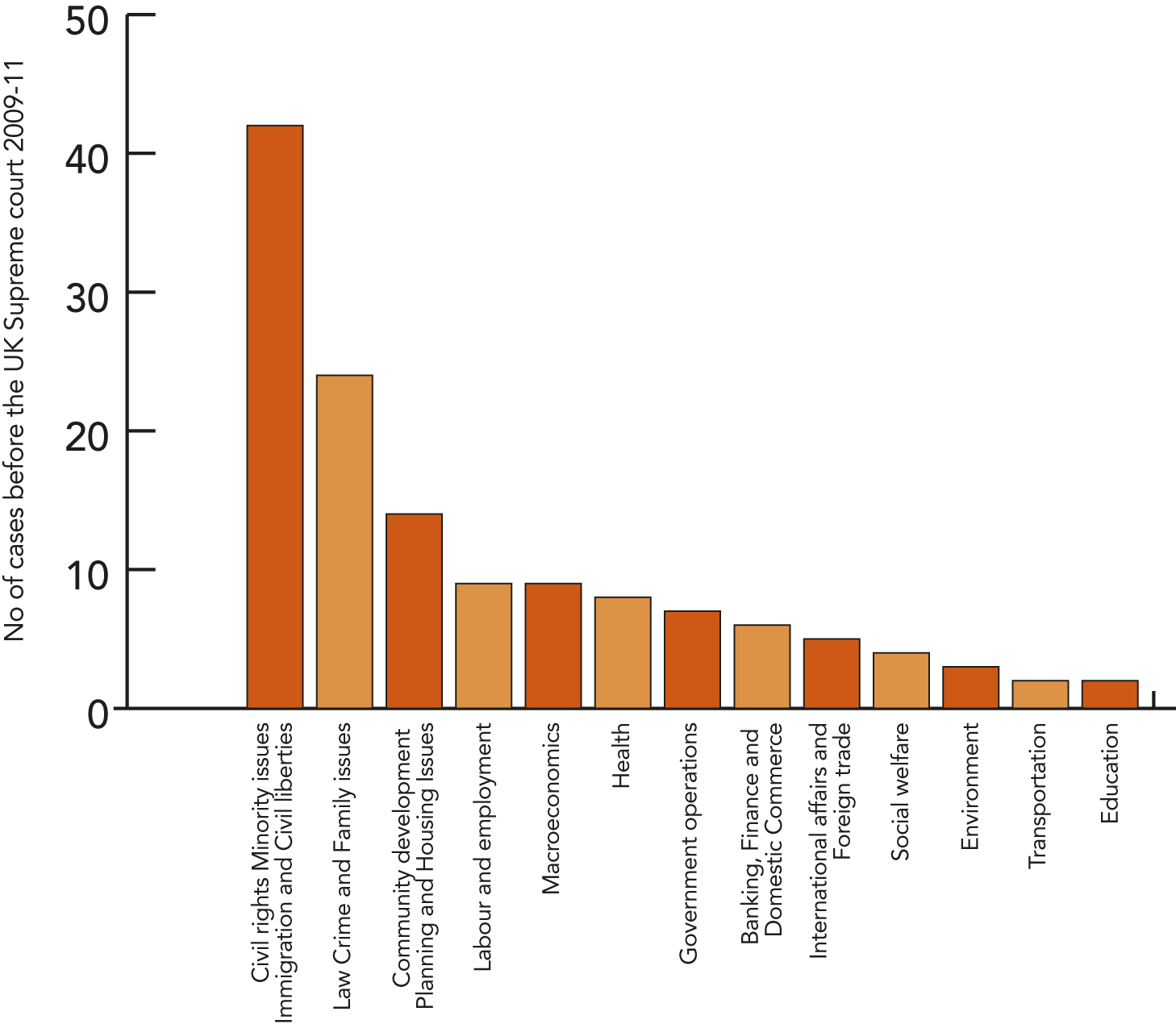
graph_1_4

How far does the Supreme Court act as a policymaker? Ruth Aitken, Hannah Smallwood & Lindsay Stirton investigate

Some 50 years ago, noted Yale political scientist Robert A Dahl drew attention to the importance of the US Supreme Court as one of the governing institutions of the US. “Decision-Making in a Democracy: The Supreme Court as a National Policy Maker”, (1957) 6 Journal of Public Law 279, was a seminal contribution to the study of “judicial politics” (as it became known). In the UK, the role of courts in making policy—particularly the senior appellate courts—has occasionally come under academic as well as broader public and political scrutiny. Yet, unlike in the US, the role of our final court as the apex of a branch of government has only rarely attracted the same attention.

At the end of the second year since the establishment of the UK Supreme Court (UKSC), we want to examine the role of the court as a national (or more accurately in the context of

If you are not a subscriber, subscribe now to read this content
If you are already a subscriber sign in
...or Register for two weeks' free access to subscriber content

MOVERS & SHAKERS

Switalskis—Naila Arif, Harriet Findlay & Ellie Thompson

Switalskis—Naila Arif, Harriet Findlay & Ellie Thompson

Firm awards training contracts to paralegals through internal programme

Ward Hadaway—Matthew Morton

Ward Hadaway—Matthew Morton

Private client disputes specialist joins commercial litigation team

Thomson Hayton Winkley—Nina Hood

Thomson Hayton Winkley—Nina Hood

Cumbria firm appoints new head of residential property

NEWS
Freezing orders in divorce proceedings can unexpectedly ensnare third parties and disrupt businesses. In NLJ this week, Lucy James of Trowers & Hamlins explains how these orders—dubbed a ‘nuclear weapon’—preserve assets but can extend far beyond spouses to companies and business partners 
A Court of Appeal ruling has clarified that ‘rent’ must be monetary—excluding tenants paid in labour from statutory protection. In this week's NLJ, James Naylor explains Garraway v Phillips, where a tenant worked two days a week instead of paying rent
Three men wrongly imprisoned for a combined 77 years have been released—yet received ‘not a penny’ in compensation, exposing deep flaws in the justice system. Writing in NLJ this week, Dr Jon Robins reports on Justin Plummer, Oliver Campbell and Peter Sullivan, whose convictions collapsed amid discredited forensics, ‘oppressive’ police interviews and unreliable ‘cell confessions’
A quiet month for employment cases still delivers key legal clarifications. In his latest Employment Law Brief for NLJ, Ian Smith reports that whistleblowing protection remains intact even where disclosures are partly self-serving, provided the worker reasonably believes they serve the ‘public interest’ 
Family law must shift from conflict-driven litigation to child-centred problem-solving, according to a major new report. Writing in NLJ this week, Caroline Bowden of Anthony Gold outlines findings showing overwhelming support for reform, with 92% agreeing lawyers owe duties to children as well as clients
back-to-top-scroll