header-logo header-logo

Judiciary celebrates 100 years of women at the Bar

18 May 2022
Categories: Legal News , Profession , Diversity
printer mail-detail
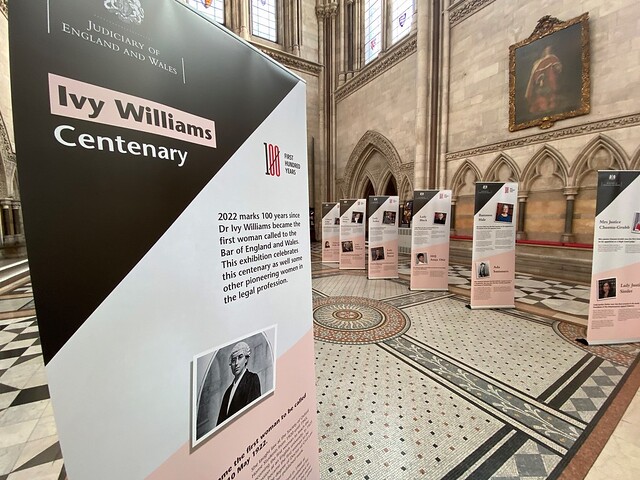
Royal Courts of Justice to display The First 100 years exhibition

A new exhibition created by charity The First 100 Years is currently on display at the Royal Courts of Justice in London.

The Ivy Williams Centenary Exhibit, which can be found in the Main Hall, features judges and other women pioneers in the legal profession from the past 100 years.

In 1922, at the age of 42, Ivy Williams was the first woman called to the bar. Williams went on to have an impressive academic career in law and she is still viewed as an inspiration to this day.

Speaking at an event to launch the exhibition, Lord Burnett Maldon, the Lord Chief Justice said: 'I am pleased to be able to mark this important centenary. Ivy Williams was the first in a long line of distinguished women to be called to the Bar and she opened the door for those women who came after her. Many of them who went on to become judges are recognised in this exhibition.'

The First 100 Years founder Dana Denis-Smith said: 'It has been a privilege to rediscover and share the stories of trailblazing women in law.

'I hope all those who pass through this important building will learn more about the contribution of women to the legal profession—history teaches us a lot about obstacles but also where opportunities can be found'.

The exhibition will also be displayed in courts around the country, starting in Oxford where Ivy Williams lived and studied.

Categories: Legal News , Profession , Diversity
printer mail-details

MOVERS & SHAKERS

Kennedys—Samson Spanier

Kennedys—Samson Spanier

Commercial disputes practice bolstered by partner hire

Bird & Bird—Emma Radcliffe

Bird & Bird—Emma Radcliffe

London competition team expands with collective actions specialist hire

Hill Dickinson—Chris Williams

Hill Dickinson—Chris Williams

Commercial dispute resolution team in London welcomes partner

NEWS
Judging is ‘more intellectually demanding than any other role in public life’—and far messier than outsiders imagine. Writing in NLJ this week, Professor Graham Zellick KC reflects on decades spent wrestling with unclear legislation, fragile precedent and human fallibility
The long-predicted death of the billable hour may finally be here—and this time, it’s armed with a scythe. In a sweeping critique of time-based billing, Ian McDougall, president of the LexisNexis Rule of Law Foundation, argues in this week's NLJ that artificial intelligence has made hourly charging ‘intellectually, commercially and ethically indefensible’
From fake authorities to rent reform, the civil courts have had a busy start to 2026. In his latest 'Civil way' column for NLJ this week, Stephen Gold surveys a procedural landscape where guidance, discretion and discipline are all under strain
Fact-finding hearings remain a fault line in private family law. Writing in NLJ this week, Victoria Rylatt and Robyn Laye of Anthony Gold Solicitors analyse recent appeals exposing the dangers of rushed or fragmented findings
As the Winter Olympics open in Milan and Cortina, legal disputes are once again being resolved almost as fast as the athletes compete. Writing in NLJ this week, Professor Ian Blackshaw of Valloni Attorneys examines the Court of Arbitration for Sport’s (CAS's) ad hoc divisions, which can decide cases within 24 hours
back-to-top-scroll