header-logo header-logo

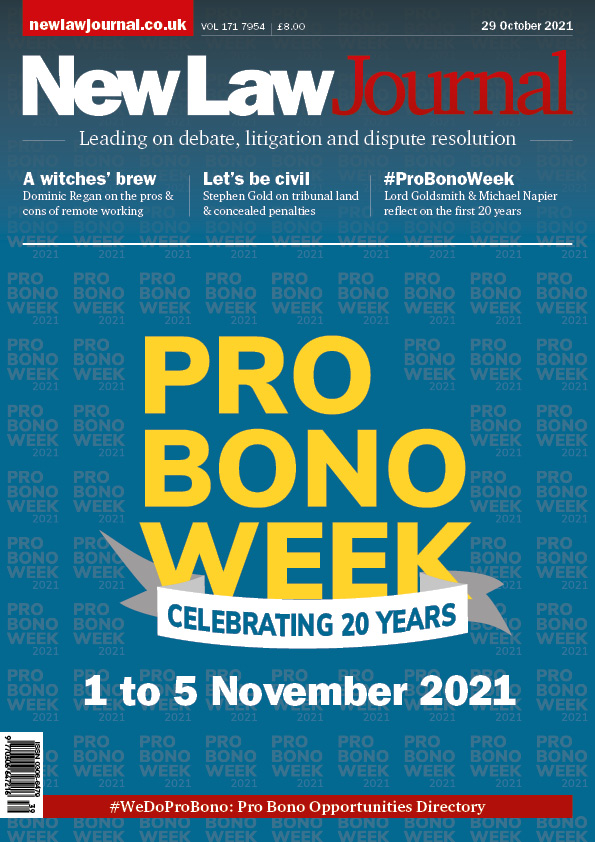
NLJ Pro Bono Week edition celebrates two decades

29 October 2021
Issue: 7954 / Categories: Legal News , Profession , Pro Bono
printer mail-detail
Lawyers up and down the country are preparing for the 20th anniversary Pro Bono Week (1-5 November)

This year’s event looks ahead to the next two decades as well as spotlighting key cases from the past.

Toby Brown, chair of the Pro Bono Week organising committee, said: ‘Last year’s Pro Bono Week saw 50 online events involving 5,000 lawyers, students and members of the charity sector discuss the challenges, and best practice, in providing pro bono during a pandemic.

‘This year, we are looking forward to taking stock at both in person and online events and discussing how in the coming years we can continue to encourage and support the profession’s pro bono efforts.’

There is something for everyone, from students to late career pro bono, and from practical tips for law clinic volunteers to advice on forming partnerships between law firms and in-house clients, as well as a Pro Bono Opportunities Directory (attached). While climate action features strongly on the agenda, there is also an event on vicarious trauma and self-care, and a contract negotiation workshop for small charities (see http://probonoweek.org.uk/events).

The launch event will take place in person and online, and will host a panel of speakers including the Attorney General, exploring the past, present and future of pro bono. Other highlights include a panel event on the rule of law and access to justice with Baroness Hale, Baroness Helena Kennedy QC, Law Society president I Stephanie Boyce and others. For a full list, see www.probonoweek.org.uk.

To set the mood and show our support, this week’s NLJ is a pro bono special edition. Features include an interview with Lord Goldsmith, former Attorney-General, and Irwin Mitchell partner Michael Napier, who both played key roles in the creation of Pro Bono Week. In a separate article, former leaders of the three main professional bodies, the Law Society, Bar Council and CILEX, look back at key moments in pro bono.

Elsewhere in the magazine (which if free to view here) judge and National Pro Bono Centre board member Sir Robin Knowles heralds the versatility and dedication of lawyers to pro bono, which can be fun, for example, ‘zigzagging across remoter parts of Wales’ or dispensing advice from a double decker bus. 


Issue: 7954 / Categories: Legal News , Profession , Pro Bono
printer mail-details

MOVERS & SHAKERS

Carey Olsen—Kim Paiva

Carey Olsen—Kim Paiva

Group partner joins Guernsey banking and finance practice

Morgan Lewis—Kat Gibson

Morgan Lewis—Kat Gibson

London labour and employment team announces partner hire

Foot Anstey McKees—Chris Milligan & Michael Kelly

Foot Anstey McKees—Chris Milligan & Michael Kelly

Double partner appointment marks Belfast expansion

NEWS
The Ministry of Justice (MoJ) has not done enough to protect the future sustainability of the legal aid market, MPs have warned
Writing in NLJ this week, NLJ columnist Dominic Regan surveys a landscape marked by leapfrog appeals, costs skirmishes and notable retirements. With an appeal in Mazur due to be heard next month, Regan notes that uncertainties remain over who will intervene, and hopes for the involvement of the Lady Chief Justice and the Master of the Rolls in deciding the all-important outcome
After the Southport murders and the misinformation that followed, contempt of court law has come under intense scrutiny. In this week's NLJ, Lawrence McNamara and Lauren Schaefer of the Law Commission unpack proposals aimed at restoring clarity without sacrificing fair trial rights
The latest Home Office figures confirm that stop and search remains both controversial and diminished. Writing in NLJ this week, Neil Parpworth of De Montfort University analyses data showing historically low use of s 1 PACE powers, with drugs searches dominating what remains
Boris Johnson’s 2019 attempt to shut down Parliament remains a constitutional cautionary tale. The move, framed as a routine exercise of the royal prerogative, was in truth an extraordinary effort to sideline Parliament at the height of the Brexit crisis. Writing in NLJ this week, Professor Graham Zellick KC dissects how prorogation was wrongly assumed to be beyond judicial scrutiny, only for the Supreme Court to intervene unanimously
back-to-top-scroll