header-logo header-logo

13 November 2020
Issue: 7910 / Categories: Legal News , Criminal , Covid-19
printer mail-detail

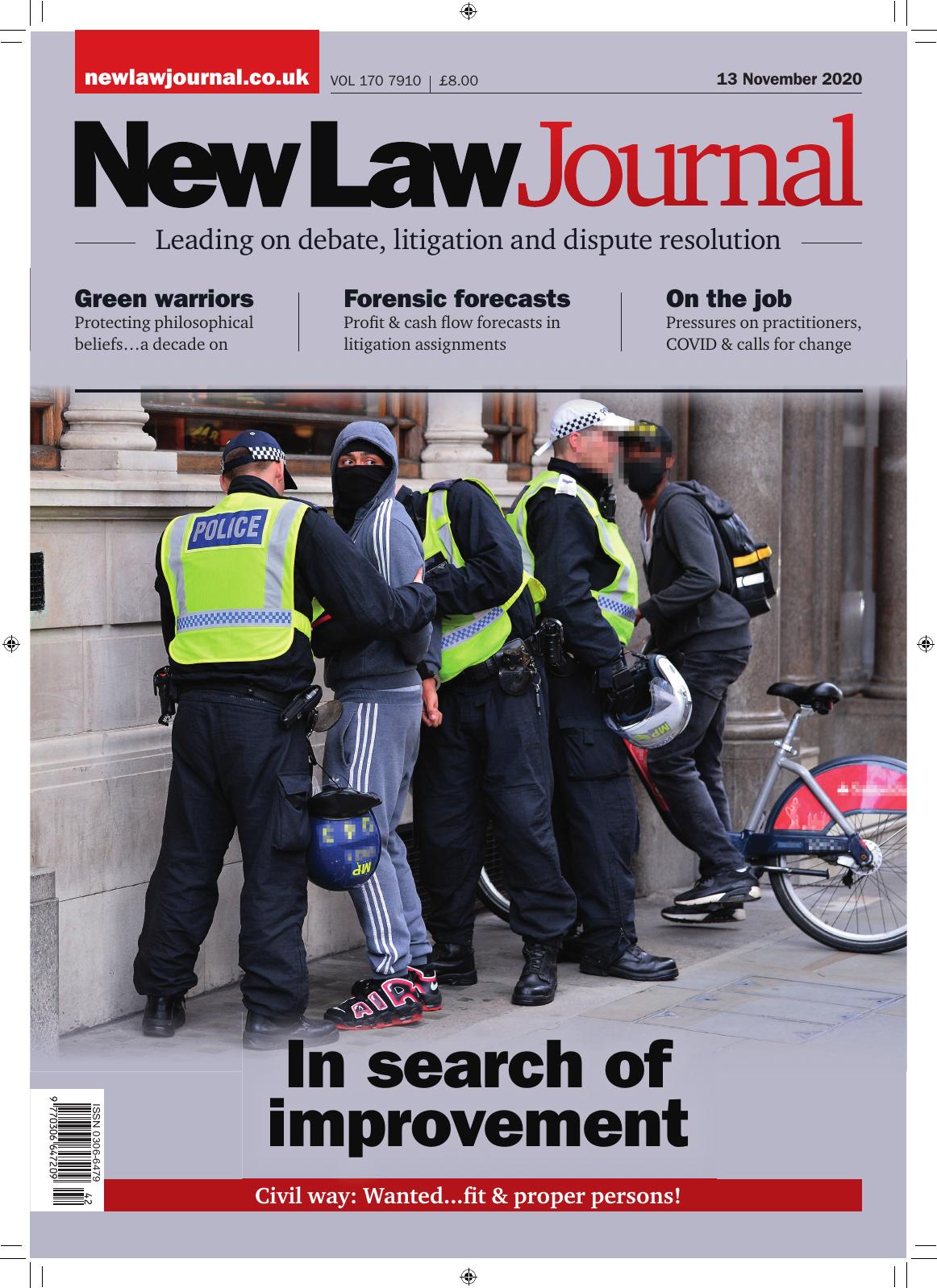
NLJ this week: Significant increase in stop & search

There has been a significant increase in the use of stop and search in the past year, Neil Parpworth of Leicester De Montfort Law School writes in this week’s NLJ
Parpworth looks into the reasons behind the recent rise and considers criticisms of the policy, particularly the fact black people are far more likely to be stopped and searched than white people.

It is ‘imperative’, he writes, that ‘the police use stop and search in a targeted and intelligence led manner,’ he writes. ‘Rises in the use of the powers need to be accompanied by improvements in stop-to-arrest ratios and find rates.’     

Issue: 7910 / Categories: Legal News , Criminal , Covid-19
printer mail-details

MOVERS & SHAKERS

Keystone Law—Milena Szuniewicz-Wenzel & Ian Hopkinson

Keystone Law—Milena Szuniewicz-Wenzel & Ian Hopkinson

International arbitration team strengthened by double partner hire

Coodes Solicitors—Pam Johns, Rachel Pearce & Bradley Kaine

Coodes Solicitors—Pam Johns, Rachel Pearce & Bradley Kaine

Firm celebrates trio holding senior regional law society and junior lawyers division roles

Michelman Robinson—Sukhi Kaler

Michelman Robinson—Sukhi Kaler

Partner joins commercial and business litigation team in London

NEWS
The Legal Action Group (LAG)—the UK charity dedicated to advancing access to justice—has unveiled its calendar of training courses, seminars and conferences designed to support lawyers, advisers and other legal professionals in tackling key areas of public interest law
The Police and Criminal Evidence Act 1984 transformed criminal justice. Writing in NLJ this week, Ed Cape of UWE and Matthew Hardcastle and Sandra Paul of Kingsley Napley trace its ‘seismic impact’
Operational resilience is no longer optional. Writing in NLJ this week, Emma Radmore and Michael Lewis of Womble Bond Dickinson explain how UK regulators expect firms to identify ‘important business services’ that could cause ‘intolerable levels of harm’ if disrupted
As the drip-feed of Epstein disclosures fuels ‘collateral damage’, the rush to cry misconduct in public office may be premature. Writing in NLJ this week, David Locke of Hill Dickinson warns that the offence is no catch-all for political embarrassment. It demands a ‘grave departure’ from proper standards, an ‘abuse of the public’s trust’ and conduct ‘sufficiently serious to warrant criminal punishment’
Employment law is shifting at the margins. In his latest Employment Law Brief for NLJ this week, Ian Smith of Norwich Law School examines a Court of Appeal ruling confirming that volunteers are not a special legal species and may qualify as ‘workers’
back-to-top-scroll