header-logo header-logo

23 June 2023
Issue: 8030 / Categories: Legal News , Criminal , Judicial review , Property
printer mail-detail

NLJ this week: Trespass or frustrated eviction? Prosecutors dig deep for the answer

127497
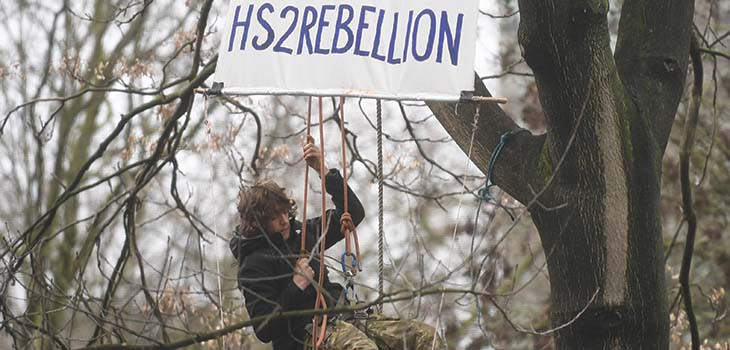
The construction of HS2 has provided work for criminal lawyers as well as construction engineers, writes NLJ columnist David Walbank KC, of Red Lion Chambers, in this week’s ‘Crime Brief’. Walbank looks at the recent case concerning protestors who tunnelled beneath Euston Square Gardens in central London.

Walbank writes: ‘The operation to evict them involved the full panoply of specialist teams and emergency services and, after an elaborate game of cat and mouse, it was another month before the site was cleared, at a cost of more than £4m.’

But was there a criminal case to answer? The prosecution, after failing to find success, applied for judicial review. The case raised several interesting questions—find the answers in the latest Crime Brief here.

Issue: 8030 / Categories: Legal News , Criminal , Judicial review , Property
printer mail-details
RELATED ARTICLES

MOVERS & SHAKERS

Thomson Hayton Winkley—Jordan Wallace

Thomson Hayton Winkley—Jordan Wallace

Thomson Hayton Winkley strengthens family law team

Ward Hadaway—Barnaby Rosenthall

Ward Hadaway—Barnaby Rosenthall

Construction lawyer returns to Ward Hadaway in Teesside role

Bird & Bird—Shahin Baghaei

Bird & Bird—Shahin Baghaei

Bird Bird hires leading legal transformation expert

NEWS
Legal aid deserts leave almost one in four without adequate access to justice
The Solicitors Regulation Authority (SRA) has warned solicitors and law firms that using artificial intelligence does not alter their professional obligations, amid concerns over inaccurate legal material and client confidentiality
From forgotten interest claims to case-management appeals, a string of procedural developments offers useful—and occasionally cautionary—lessons for practitioners

Jonathan Fisher KC highlights that it now accounts for around 40% of criminal offences, with roughly 70% involving technology, and argues that the UK cannot simply prosecute its way out of the problem. Detection, investigation and prosecution all require improvement, while different fraud types demand tailored responses.

How forcefully can a litigant criticise a public authority before robust advocacy crosses the line into unreasonable conduct? 
back-to-top-scroll