header-logo header-logo

Out in the cold: time to axe the Legal Aid Agency?

13 October 2017 / Dr Jon Robins
Issue: 7765 / Categories: Opinion , Legal aid focus , Profession
printer mail-detail
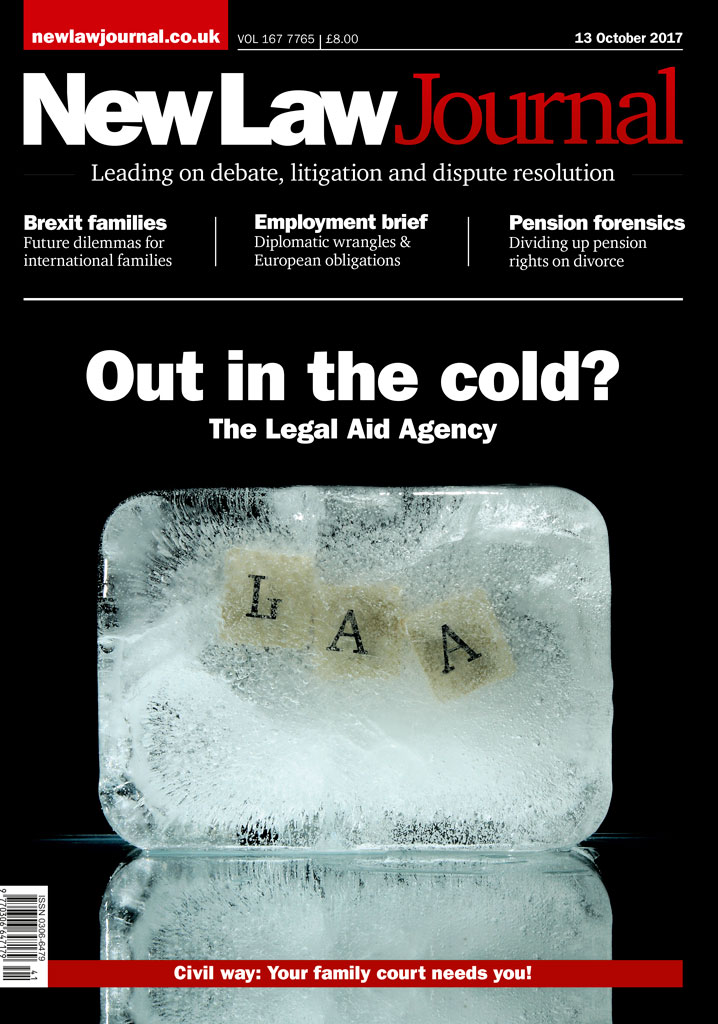
nlj_7765_cover

If the Legal Aid Agency is to have a future it should be focused on enabling access to justice not refusing legal aid, says Jon Robins

It is a bitter irony that the one part of the Ministry of Justice seemingly untouched by austerity (until recently, at least) has been the Legal Aid Agency’s (LAA’s) own running costs. Despite decades of frozen legal aid rates followed by the recent round of brutal cuts, the administrative costs of the LAA have been heading north since it was created in 2013. Meanwhile, the ministry’s overall budget having been cut by 25% since LASPO (the Legal Aid, Sentencing and Punishment of Offenders Act 2012).

The Bach Commission on Access to Justice, published last month, has called for the LAA to be axed—as has the Legal Aid Practitioners Group (LAPG) which published the second edition of its manifesto last week ( Manifesto for Legal Aid , Legal Aid Practitioners Group, 2nd edition 2017). Rightly, both groups focus their

If you are not a subscriber, subscribe now to read this content
If you are already a subscriber sign in
...or Register for two weeks' free access to subscriber content

MOVERS & SHAKERS

DAC Beachcroft—Ben Daniels

DAC Beachcroft—Ben Daniels

Firm elects new senior partner to lead next phase of growth

Taylor Rose—Amarjit Ryatt

Taylor Rose—Amarjit Ryatt

Partner appointed head of family and divorce

Browne Jacobson—Adam Berry & Adam Culy

Browne Jacobson—Adam Berry & Adam Culy

Financial and professional risks team expand with dual partner hire

NEWS
The High Court’s decision in Mazur v Charles Russell Speechlys has thrown the careers of experienced CILEX litigators into jeopardy, warns Fred Philpott of Gough Square Chambers in NLJ this week
Sir Brian Leveson’s claim that there is ‘no right to jury trial’ erects a constitutional straw man, argues Professor Graham Zellick KC in NLJ this week. He argues that Leveson dismantles a position almost no-one truly holds, and thereby obscures the deeper issue: the jury’s place within the UK’s constitutional tradition
Why have private prosecutions surged despite limited data? Niall Hearty of Rahman Ravelli explores their rise in this week's NLJ 
The public law team at Herbert Smith Freehills Kramer surveys significant recent human rights and judicial review rulings in this week's NLJ
In this week's NLJ, Mary Young of Kingsley Napley examines how debarring orders, while attractive to claimants seeking swift resolution, can complicate trials—most notably in fraud cases requiring ‘particularly cogent’ proof
back-to-top-scroll