


Although laboratory testing using blood, hair and nail samples can provide a historic overview of a client’s alcohol consumption, alcohol monitoring technology can be very powerful for monitoring their current and ongoing use of alcohol.
This technology includes real-time monitoring in the form of breathalysers, and continuous alcohol monitoring using ankle monitors, both of which can be used to monitor alcohol consumption and encourage client accountability.
Ankle monitoring tags
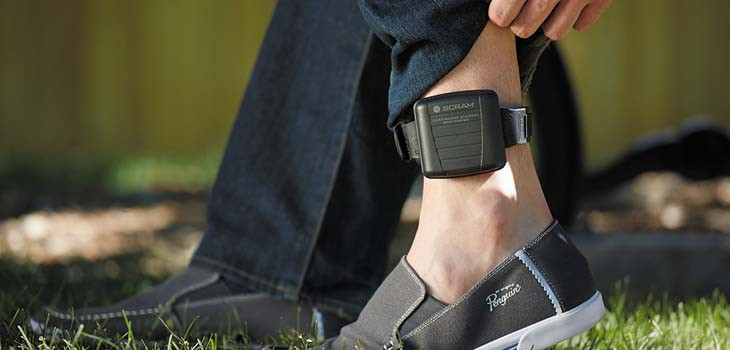
An ankle monitoring tag is a non-invasive device that can be worn discreetly around the ankle, detecting traces of alcohol in sweat.
At AlphaBiolabs, we offer SCRAM Continuous Alcohol Monitoring® (SCRAM CAM®), an ankle bracelet that monitors alcohol consumption 24 hours a day, seven days a week, for as long as the device is worn.
The bracelet works by using transdermal analysis to sample and test the perspiration that is always on the skin, known as insensible perspiration.
Firstly, a pump inside the bracelet takes in the sample. Then a fuel cell, just like the kind used in breath test devices, reacts with ethanol to measure the presence of alcohol. A sample of insensible perspiration is taken automatically every 30 minutes to measure for alcohol consumption.
For reporting purposes, testing data is transferred from the device to a separate base station inside the client’s premises. The base station communicates directly with the online monitoring system, uploading daily alerts which can be reviewed by the instructing party, with any drinking events flagged by the next working day.
Breath testing
Breath testing using a breathalyser device is most used by law enforcement for roadside alcohol testing but can also be used as a form of longer-term monitoring.
Our recommended breath testing for family law firms and local authorities overseeing co-parenting, custody and access arrangements is the SmartMobile™ Portable Alcohol Monitoring device.
A small, handheld testing device, SmartMobile provides scheduled, random, and on-demand breath alcohol testing, requiring the user to blow into a removable mouthpiece.
A built-in camera provides facial detection to prevent tampering and optional GPS tracking is also a feature.
The device uploads the test data to an online portal after each test is completed, from which reports can then be downloaded.
Scaled monitoring
Both SCRAM CAM and SmartMobile can be used independently, depending on the preference of the parties involved. They can also be used in succession, as part of a scaled monitoring programme.
Where alcohol testing has been performed using blood, hair or nail samples, and alcohol intake has been reduced, an ankle tag such as the SCRAM CAM bracelet is the next logical step in monitoring.
Most suitable for higher risk clients, it requires no active participation, as the bracelet is always worn around the ankle, and automatically takes readings every 30 minutes. When used in family law and childcare proceedings, it is a highly effective assessment tool for individuals struggling with alcohol misuse or seeking to produce evidence for courts regarding acceptable drinking behaviours.
Where clients have reduced their alcohol intake while wearing the SCRAM CAM, SmartMobile can then be used as a follow-up method of monitoring, encouraging participation in the form of scheduled breath tests, and placing more accountability on the client.
SmartMobile is most useful for lower-risk alcohol users and is particularly suitable for clients with joint custody of children or who only require monitoring at the times when the children are in their care.
Whatever the reasons for monitoring, both SCRAM CAM and SmartMobile eliminate the need for the client to attend testing centres – a significant benefit for all involved.
Court-approved alcohol monitoring from AlphaBiolabs
Understanding alcohol monitoring technology and the benefits of different testing devices, can help you make the best decision for your client.
Our nationwide network of professional sample collectors are fully trained to set up both forms of alcohol monitoring technology, and our test results are accepted by Family Courts, the Ministry of Justice, and the Child Maintenance Service.
Legal clients can claim 10% off SCRAM CAM® and SmartMobile™ alcohol monitoring until 31 December 2022, including free weekly, fortnightly, or monthly reporting for both systems, and free daily alerts for SCRAM. Simply cite ALC10 when requesting your quote.
For expert advice on which solution would best suit your client, call our Customer Services team on 0333 600 1300 or email testing@alphabiolabs.com and a member of our Legal team will be in touch.
Image: © Shutterstock

Rachel Davenport is Co-founder and Director at AlphaBiolabs, the UK’s leading laboratory providing UKAS-accredited DNA, drug, and alcohol testing services for the legal sector. Since establishing the company in 2004, Rachel has continued to ensure that the range of services offered remain at the forefront of innovation and value, supporting family law professionals, social workers, and local authorities with court-approved solutions for family law cases.
For further information please contact AlphaBiolabs on 0333 600 1300, email testing@alphabiolabs.com or visit www.alphabiolabs.co.uk


