



Scientific advances in DNA analysis make it easier than ever to establish a relationship between family members in support of immigration applications. However, the use of DNA evidence in immigration cases has not been without controversy.
In 2018, Home Secretary Sajid Javid was forced to apologise when it was revealed that a significant number of immigrants had been advised that DNA testing was mandatory for certain family visa applications, without any legal basis for such a requirement. In fact, the submission of DNA evidence in support of an immigration application is entirely voluntary, with Home Office DNA policy guidance later being updated to acknowledge that the department did not have the power to make such a request.
How is a DNA test useful?
While documents such as birth or marriage certificates will usually be enough to prove a relationship for immigration cases, DNA tests can prove invaluable, provided the applicant has independently decided to submit DNA evidence to support a relationship (as they cannot be asked to do so by officials).
Examples include:
- If a child is born abroad to UK citizens and parents are seeking citizenship for the child. In this instance, the individual may choose to have a paternity or maternity test to confirm parentage.
- If a relative plans to move to the UK and they want to submit DNA evidence to confirm a familial relationship (where a UK citizen is sponsoring them for citizenship or a visa), they may decide to have a complex relationship DNA test performed. These types of tests can be used to verify a biological relationship between siblings, grandparents and their grandchildren, nieces and nephews and their uncle(s) or aunt(s) or even tell us the likelihood of two or more people being cousins.
In recent years, we have seen an increase in demand for complex relationship testing, as UK citizens make a case for bringing members of their extended family to the UK.
In the past such tests could only draw one of two conclusions—whether the subjects were related or unrelated. However, technological advances mean we are now able to paint a more complete picture of a person’s family tree. For example, if a person is seeking UK citizenship for multiple children, DNA testing would be able to determine which of those children are sons or daughters, or if any the children are in fact more likely to be nieces or nephews of the applicant.
Whatever the circumstances, it is important to note that DNA tests for this purpose must meet a certain standard to be provided as evidence. This includes the requirement for the test to be performed by a Home Office approved ISO 17025-accredited testing laboratory, and for samples to be collected under strict chain of custody conditions.
DNA sample collection
When performing DNA testing for immigration, a cheek (buccal) swab is rubbed on the inside of each donor’s cheek to obtain DNA for analysis.
The DNA samples of the individuals are then analysed and compared to determine whether they share enough matching DNA markers (alleles). If they share enough DNA markers, they are likely to be biologically related (eg parent and child, aunt/uncle and niece/nephew, full or half-siblings, cousins etc.). An AlphaBiolabs DNA test can analyse and compare up to 42 DNA markers for a conclusive result.
When testing a person in a foreign country, a Home Office approved laboratory will be well-versed in collecting DNA samples from individuals living abroad. A sample collection kit is sent to the required foreign location, and an appointment can be arranged via a local GP, medical practice, hospital, or another approved clinic in the applicant’s country. The DNA samples are then collected (both in the UK and abroad) under chain of custody, with the donors required to provide a form of ID, and two passport sized photos that are signed by the collector at the time the samples are obtained.
Reuniting families using DNA evidence
Using the very latest scientific methods for DNA analysis, we can verify how individuals are related, strengthen immigration applications, and reunite families with their loved ones in the UK.
As a UKAS-accredited testing laboratory, AlphaBiolabs has worked with British Embassies and some of the largest specialist immigration solicitors in the UK for 18 years. Our DNA immigration tests are recognised and admissible to UK courts, the Ministry of Justice, the UK Visas and Immigration Service and HM Passport Office.
We operate alongside a large international network of sample collectors, who work closely with immigration centres, consulates, and embassies worldwide to ensure a fast and efficient service, collecting samples from over 90 different countries worldwide. We also offer free sample collection for legal clients at our walk-in centres across the UK.
Legal clients can claim 50 per cent off all AlphaBiolabs DNA tests until 30th April 2022 by quoting DNA50 when placing an order.
For expert advice on which DNA test is best for your client, call the AlphaBiolabs Customer Services team on 0330 600 1300 or email testing@alphabiolabs.com.
Casey Randall
Head of DNA and Covid Testing at AlphaBiolabs
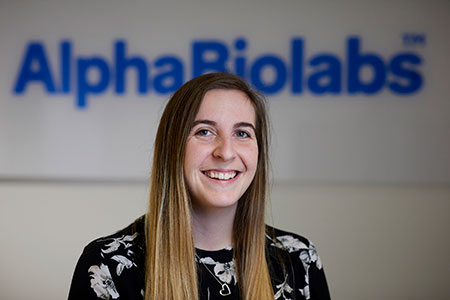
Casey heads up both the DNA and Covid-19 testing teams. An expert in DNA analysis and a member of the International Society for Forensic Genetics (ISFG), Casey holds an MSc with Distinction in DNA Profiling and a First-Class BSc with Honours in Forensic
Science.



