header-logo header-logo

05 May 2021 / Dr Jon Robins
Issue: 7931 / Categories: Opinion , Criminal
printer mail-detail

Post Office: far from the end of the road?

48106
The Post Office scandal is just one example of miscarriage of justice in a system which is no longer fit for purpose, says Jon Robins

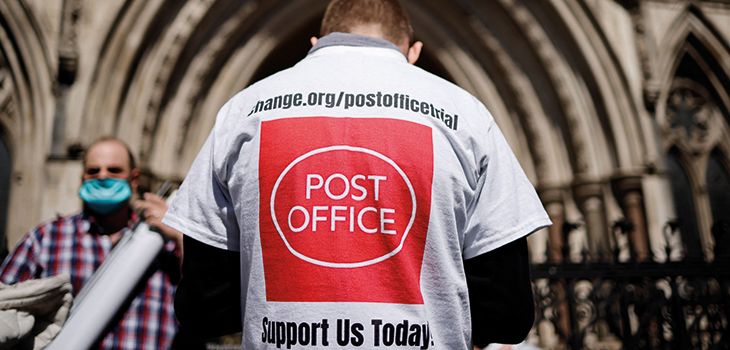
The success of the former sub-postmasters in the Court of Appeal last month has been described as ‘the biggest miscarriage of justice in British legal history’. Each of those 39 wrongful convictions represents years of untold misery for the individuals concerned, as well as for their loved ones. Many lost their homes, livelihoods, health and, in some cases, their liberty.

One case among many

It can take years for a miscarriage of justice to unravel, and all too often an injustice is seemingly revealed never to be corrected; in that respect, the sub-postmasters have been ‘lucky’. Shortly after the appeal judges gave their momentous judgment, it was reported that a man who spent 17 years in jail protesting his innocence had won a major step forward in his fight to clear his name.

Andrew Malkinson, whose case was championed by

If you are not a subscriber, subscribe now to read this content
If you are already a subscriber sign in
...or Register for two weeks' free access to subscriber content

MOVERS & SHAKERS

Jackson Lees Group—Jannina Barker, Laura Beattie & Catherine McCrindle

Jackson Lees Group—Jannina Barker, Laura Beattie & Catherine McCrindle

Firm promotes senior associate and team leader as wills, trusts and probate team expands

Asserson—Michael Francos-Downs

Asserson—Michael Francos-Downs

Manchester real estate finance practice welcomes legal director

McCarthy Denning—Harvey Knight & Martin Sandler

McCarthy Denning—Harvey Knight & Martin Sandler

Financial services and regulatory offering boosted by partner hires

NEWS
Holiday lets may promise easy returns, but restrictive covenants can swiftly scupper plans. Writing in NLJ this week, Andrew Francis of Serle Court recounts how covenants limiting use to a ‘private dwelling house’ or ‘private residence’ have repeatedly defeated short-term letting schemes
Artificial intelligence (AI) is already embedded in the civil courts, but regulation lags behind practice. Writing in NLJ this week, Ben Roe of Baker McKenzie charts a landscape where AI assists with transcription, case management and document handling, yet raises acute concerns over evidence, advocacy and even judgment-writing
The Supreme Court has drawn a firm line under branding creativity in regulated markets. In Dairy UK Ltd v Oatly AB, it ruled that Oatly’s ‘post-milk generation’ trade mark unlawfully deployed a protected dairy designation. In NLJ this week, Asima Rana of DWF explains that the court prioritised ‘regulatory clarity over creative branding choices’, holding that ‘designation’ extends beyond product names to marketing slogans
From cat fouling to Part 36 brinkmanship, the latest 'Civil way' round-up is a reminder that procedural skirmishes can have sharp teeth. NLJ columnist Stephen Gold ranges across recent decisions with his customary wit
Digital loot may feel like property, but civil law is not always convinced. In NLJ this week, Paul Schwartfeger of 36 Stone and Nadia Latti of CMS examine fraud involving platform-controlled digital assets, from ‘account takeover and asset stripping’ to ‘value laundering’
back-to-top-scroll