header-logo header-logo

THIS ISSUE
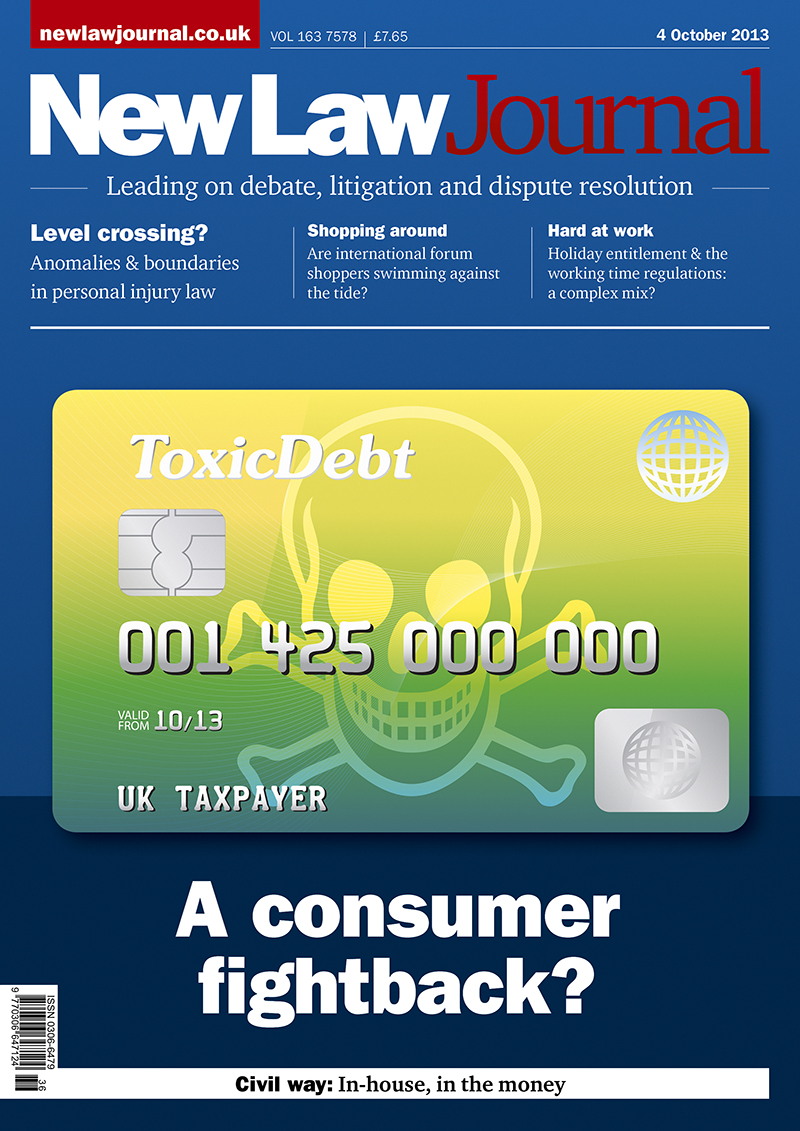
Card image

Issue: Vol 163, Issue 7578

04 October 2013
IN THIS ISSUE

Pensionsversicherungsanstalt v Brey C-140/12, [2013] All ER (D) 198 (Sep)

R (on the application of D) v General Medical Council [2013] EWHC 2839 (Admin), [2013] All ER (D) 202 (Sep)

Martin Y Paz Diffusion SA v Depuydt and another C-661/11, [2013] All ER (D) 208 (Sep)

Peter Thompson QC explains why UK taxpayers deserve an amnesty

Event attracts nationwide tweeters

Regulators criticised by Council of Mortgage Lenders

What can be done to ease the burden of the individual taxpaying debtor?

Section 40 of the Equality Act 2010 is abolished

Social media has made a significant contribution to legal business development

Safety at level crossings to be improved

Show
10
Results
Results
10
Results

MOVERS & SHAKERS

NLJ Career Profile: Maryam Syed KC, Church Court Chambers

NLJ Career Profile: Maryam Syed KC, Church Court Chambers

From childhood dreams of the Bar to some of the country's most challenging cases, Maryam Syed KC explains why she has never stopped standing up for others

DAC Beachcroft—Richard Breavington, Rachel Ford & Daniel Guilfoyle

DAC Beachcroft—Richard Breavington, Rachel Ford & Daniel Guilfoyle

DAC Beachcroft significantly expands Cyber team, hiring three Cyber partners

Browne Jacobson—Professor Clive Kay

Browne Jacobson—Professor Clive Kay

Browne Jacobson appoints senior healthcare leader Professor Clive Kay as strategic adviser

NEWS
As family justice moves further away from the courtroom, collaborative law is emerging as an increasingly important route to resolving separation disputes
A busy period for employment law is producing important lessons for employers, employees and tribunals alike
From forgotten interest claims to case-management appeals, a string of procedural developments offers useful—and occasionally cautionary—lessons for practitioners

Jonathan Fisher KC highlights that it now accounts for around 40% of criminal offences, with roughly 70% involving technology, and argues that the UK cannot simply prosecute its way out of the problem. Detection, investigation and prosecution all require improvement, while different fraud types demand tailored responses.

How forcefully can a litigant criticise a public authority before robust advocacy crosses the line into unreasonable conduct? 
back-to-top-scroll