header-logo header-logo

THIS ISSUE
Card image

Issue: Vol 172, Issue 7983

17 June 2022
IN THIS ISSUE

In this week’s 'Civil Way', former District Judge Stephen Gold shines his light on the debt respite scheme, specifically a case where a debtor benefited from a mental health crisis moratorium, rendering the eviction and sale of a flat null and void

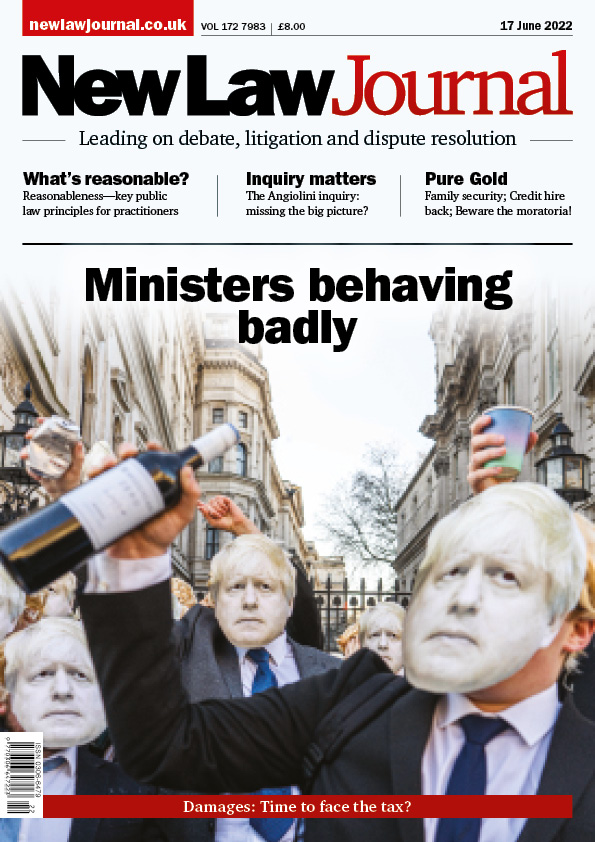
How do we assess the standards for ministerial misconduct, and how can we maintain public trust in government when ministers including prime ministers behave badly or don’t seem to care?

How to assess the standards for ministerial misconduct? John Gould reports on the slippery slope leading to loss of public trust
Litigation PR: Justin Penrose reports on a key tool for controlling the narrative of disputes
Taking action on culture change in the legal sector is imperative says Elizabeth Rimmer
Francisco Alvarez & Shofiq Miah on the importance of bearing in mind the taxation consequences when dealing with damages
Ruth Broadbent examines the scope of the inquiry into Sarah Everard’s murder: what exactly does it seek to prevent, & how far is it willing to go?
Catherine Taskis QC & Michael Ranson explore key public law principles of reasonableness for property practitioners
Has the SFO’s pursuit of corporate scalps undermined its original mission? Neil Swift reports on its successes & shortcomings

Beware the moratoria; Look, no update!; Loadsavouchers; Family security; Credit hire back

Show
10
Results
Results
10
Results

MOVERS & SHAKERS

Thackray Williams—Lucy Zhu

Thackray Williams—Lucy Zhu

Dual-qualified partner joins as head of commercial property department

Morgan Lewis—David A. McManus

Morgan Lewis—David A. McManus

Firm announces appointment of next chair

Burges Salmon—Rebecca Wilsker

Burges Salmon—Rebecca Wilsker

Director joins corporate team from the US

NEWS
What safeguards apply when trust corporations are appointed as deputy by the Court of Protection? 
Disputing parties are expected to take part in alternative dispute resolution (ADR), where this is suitable for their case. At what point, however, does refusing to participate cross the threshold of ‘unreasonable’ and attract adverse costs consequences?
When it comes to free legal advice, demand massively outweighs supply. 'Millions of people are excluded from access to justice as they don’t have anywhere to turn for free advice—or don’t know that they can ask for help,' Bhavini Bhatt, development director at the Access to Justice Foundation, writes in this week's NLJ
When an ex-couple is deciding who gets what in the divorce or civil partnership dissolution, when is it appropriate for a third party to intervene? David Burrows, NLJ columnist and solicitor advocate, considers this thorny issue in this week’s NLJ
NLJ's latest Charities Appeals Supplement has been published in this week’s issue
back-to-top-scroll