

THIS ISSUE

NLJ's latest Charities Appeals Supplement has been published in this week's issue
Beware of glass cubes, or at least those who intend to build them, warns former District Judge Stephen Gold, in this week’s 'Civil way'.
When does legal professional privilege apply? That was the nub of the issue in the recent case of Loreley Financing (Jersey) v Credit Suisse. Writing in this week’s NLJ, Rhys Novak and Emilie Brammer look into the details of the case and assess the two-stage test set out by the High Court.
In the second in a series of articles in NLJ on child abductions, Mani Singh Basi looks at cases where children go on holiday and are not returned home.
Judges are responding to recent examples of judgment embargoes being breached by imposing conditions on parties, according to Mary Young and Rebecca Ryan in this week’s NLJ.
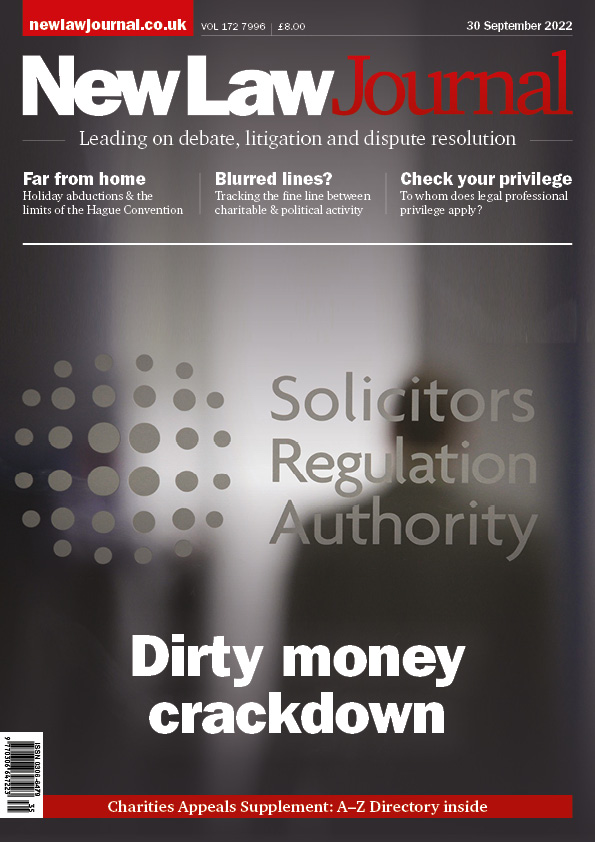
Solicitors are prime targets for those who want to wash their ‘dirty’ money, says Paul Philip

Mani Singh Basi examines the benefits & limitations of the Hague Convention in child abduction cases
Mark Pawlowski asks whether it is time to reconsider the line between charity & political activities
Can the identity of those instructing lawyers be protected by privilege? Emilie Brammer & Rhys Novak assess the two-stage test set out by the High Court
Masood Ahmed examines the court’s approach to a party’s non-attendance at trial, & the high bar for applications to set aside the resulting judgment

MOVERS & SHAKERS


Clyde & Co—Suriya Ashok
Clyde Co strengthens energy transition and construction offering with hire of Suriya Ashok

Jurit—Nicole Gallop Mildon
Jurit appoints rare dual-qualified lawyer to expand Anglo-French private wealth expertise

Twenty Essex—Thomas Hibbs, Jack Hollingworth & Sam Pearce
Three new tenants join Twenty Essex
NEWS
The Financial Reporting Council’s revised Audit Enforcement Procedure will alter the balance of power in corporate investigations
A telecoms operator may be able to hold over under the Landlord and Tenant Act 1954, yet still be unable to secure a renewal: an outcome described as a legal ‘paradox’
Safety fears do not automatically justify shutting an interested person out of a statutory will application
Consumer credit law is heading for its biggest shake-up in 50 years, with the Consumer Credit Act 1974 set to yield much of its detailed statutory machinery to FCA rules
The Supreme Court has settled a long-running dispute over part-time workers: unfavourable treatment need be a significant or effective cause, not the sole cause
Copyright © 2026 LexisNexis

