header-logo header-logo

14 May 2021 / Alec Samuels
Issue: 7932 / Categories: Features , Profession
printer mail-detail

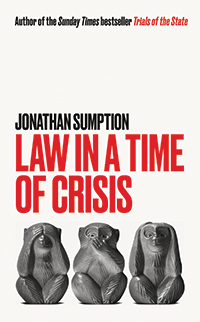
Book review: Law in a time of crisis

48984
  • Author: Jonathan Sumption
  • Publisher: Profile Books Ltd
  • ISBN: 9781788167116
  • Price: £16.99

Released from the restraints of judicial office, Lord Sumption is once again a free spirit, crisply, elegantly, logically and challengingly examining our cherished legal institutions and theories and practices. It is a pity that Lord Sumption is not a real lord anymore, not eligible as a retired law lord to sit in the legislature.

As good old Lord Denning used to say, a good judge has to be more than a mere lawyer—he must be a man of science or maths or history or literature or philosophy or whatever. Sumption was eminently well qualified—a scholarly historian, especially in mediaeval history, of real repute. Aristotle, Coke, Dicey, Marx, Hemingway, all are quoted, among others. He found the old law reports and the Oxford Dictionary of National Biography very useful in his cases. As a distinguished historian, he did not approve of statue wreckers; rage against the past is pointless.

Diversity in the judiciary has become

If you are not a subscriber, subscribe now to read this content
If you are already a subscriber sign in
...or Register for two weeks' free access to subscriber content

MOVERS & SHAKERS

Thomson Hayton Winkley—Jordan Wallace

Thomson Hayton Winkley—Jordan Wallace

Thomson Hayton Winkley strengthens family law team

Ward Hadaway—Barnaby Rosenthall

Ward Hadaway—Barnaby Rosenthall

Construction lawyer returns to Ward Hadaway in Teesside role

Bird & Bird—Shahin Baghaei

Bird & Bird—Shahin Baghaei

Bird Bird hires leading legal transformation expert

NEWS
Legal aid deserts leave almost one in four without adequate access to justice
The Solicitors Regulation Authority (SRA) has warned solicitors and law firms that using artificial intelligence does not alter their professional obligations, amid concerns over inaccurate legal material and client confidentiality
From forgotten interest claims to case-management appeals, a string of procedural developments offers useful—and occasionally cautionary—lessons for practitioners

Jonathan Fisher KC highlights that it now accounts for around 40% of criminal offences, with roughly 70% involving technology, and argues that the UK cannot simply prosecute its way out of the problem. Detection, investigation and prosecution all require improvement, while different fraud types demand tailored responses.

How forcefully can a litigant criticise a public authority before robust advocacy crosses the line into unreasonable conduct? 
back-to-top-scroll