header-logo header-logo

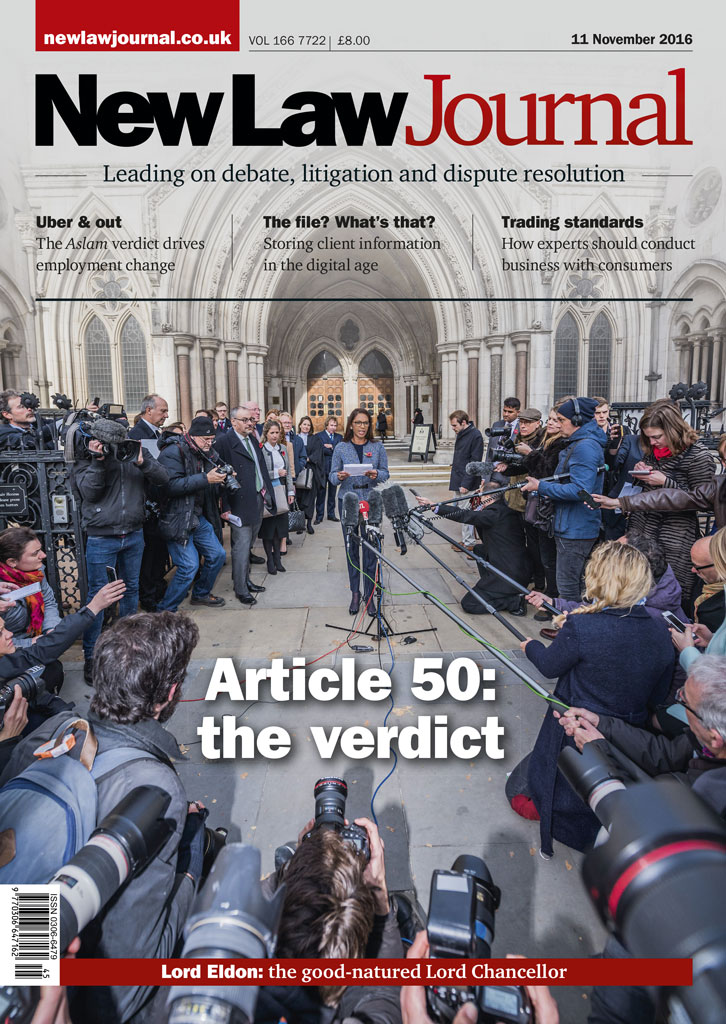
Art 50: the clash of the Brexit case arguments

01 December 2016 / Michael Zander KC
Issue: 7725 / Categories: Features , Public , Brexit , EU
printer mail-detail
nlj_7725_zander

Michael Zander QC reviews the written cases of the government & the lead claimants in next week’s Supreme Court hearing

  • The two sides have opposite approaches to the relevant materials, each backed by many authorities and strong arguments.
  • The hearing is scheduled to last four days from 5 December with judgment expected in January.

The government’s appeal against the Divisional Court’s unanimous ruling in Miller and Dos Santos v Secretary of State for Exiting the EU [2016] EWHC 2768 (Admin), [2016] All ER (D) 19 (Nov) opens on Monday (5 December 2016), for the first time with all 11 justices sitting.

The government (appellant) will again be represented by the attorney general and Mr J Eadie QC. The lead claimants (now the respondents) will again be represented by Lord Pannick QC (both written cases can be accessed here).

The government’s case is that triggering Art 50 is within the executive’s power acting on the international plane under the royal prerogative and that “the

If you are not a subscriber, subscribe now to read this content
If you are already a subscriber sign in
...or Register for two weeks' free access to subscriber content

MOVERS & SHAKERS

Kingsley Napley—Tristan Cox-Chung

Kingsley Napley—Tristan Cox-Chung

Firm bolsters restructuring and insolvency team with partner hire

Foot Anstey—Stephen Arnold

Foot Anstey—Stephen Arnold

Firm appoints first chief client officer

Mewburn Ellis—Aled Richards-Jones

Mewburn Ellis—Aled Richards-Jones

IP firm welcomes experienced patent litigator as partner

NEWS
Solicitors are installing panic buttons and thumb print scanners due to ‘systemic and rising’ intimidation including death and arson threats from clients
Ministers’ decision to scrap plans for their Labour manifesto pledge of day one protection from unfair dismissal was entirely predictable, employment lawyers have said
Paper cyber-incident plans are useless once ransomware strikes, argues Jack Morris of Epiq in NLJ this week
In this week's NLJ, Robert Hargreaves and Lily Johnston of York St John University examine the Employment Rights Bill 2024–25, which abolishes the two-year qualifying period for unfair-dismissal claims
Writing in NLJ this week, Manvir Kaur Grewal of Corker Binning analyses the collapse of R v Óg Ó hAnnaidh, where a terrorism charge failed because prosecutors lacked statutory consent. The case, she argues, highlights how procedural safeguards—time limits, consent requirements and institutional checks—define lawful state power
back-to-top-scroll