header-logo header-logo

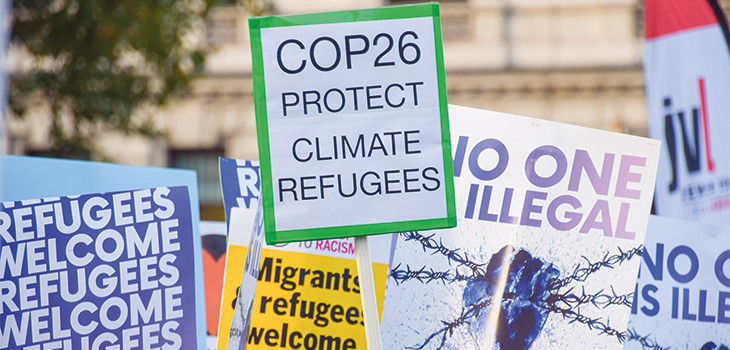
Climate refugees: a 21st century crisis

24 November 2021 / Sharmistha Michaels
Issue: 7958 / Categories: Opinion , Immigration & asylum
printer mail-detail
65084
Is the law in place to protect people who are forcibly displaced by environmental disaster? Sharmistha Michaels investigates

The world has warmed up by around 1.2°C since the 19th century. This has had a catastrophic effect on civilization: global sea levels reaching a record high; Greenland’s enormous ice sheet melting faster than ever; floods deluging parts of Europe and China; and wildfires raging through forests and homes worldwide (see the World Meteorological Organization’s report State of Climate in 2021).

Novels like John Lanchester’s The Wall paint a dystopian picture of millions of people across the globe being displaced by climate change and seeking shelter. Britain’s response is to create a wall of its coastline to bar entry, in keeping with its post-Brexit anti-refugee attitude. Tales like his are no longer harbingers of a future dystopian crisis. The crisis is here now. Numbers affected are growing fast. By 2030, climate change could force 216 million people to migrate as hotspots of internal climate migration start to emerge (see the World

If you are not a subscriber, subscribe now to read this content
If you are already a subscriber sign in
...or Register for two weeks' free access to subscriber content

MOVERS & SHAKERS

Pillsbury—Peter O’Hare

Pillsbury—Peter O’Hare

Partner hire bolstersprivate capital and global aviation finance offering

Morae—Carla Mendy

Morae—Carla Mendy

Digital and business solutions firm appoints chief operating officer

Twenty Essex—Clementine Makower & Stephen Du

Twenty Essex—Clementine Makower & Stephen Du

Set welcomes two experienced juniors as new tenants

NEWS
The High Court’s decision in Mazur v Charles Russell Speechlys has thrown the careers of experienced CILEX litigators into jeopardy, warns Fred Philpott of Gough Square Chambers in NLJ this week
Sir Brian Leveson’s claim that there is ‘no right to jury trial’ erects a constitutional straw man, argues Professor Graham Zellick KC in NLJ this week. He argues that Leveson dismantles a position almost no-one truly holds, and thereby obscures the deeper issue: the jury’s place within the UK’s constitutional tradition
Why have private prosecutions surged despite limited data? Niall Hearty of Rahman Ravelli explores their rise in this week's NLJ 
The public law team at Herbert Smith Freehills Kramer surveys significant recent human rights and judicial review rulings in this week's NLJ
In this week's NLJ, Mary Young of Kingsley Napley examines how debarring orders, while attractive to claimants seeking swift resolution, can complicate trials—most notably in fraud cases requiring ‘particularly cogent’ proof
back-to-top-scroll