header-logo header-logo

24 April 2026 / Thomas Boyce
Issue: 8158 / Categories: Features , Profession , Diversity , Equality
printer mail-detail

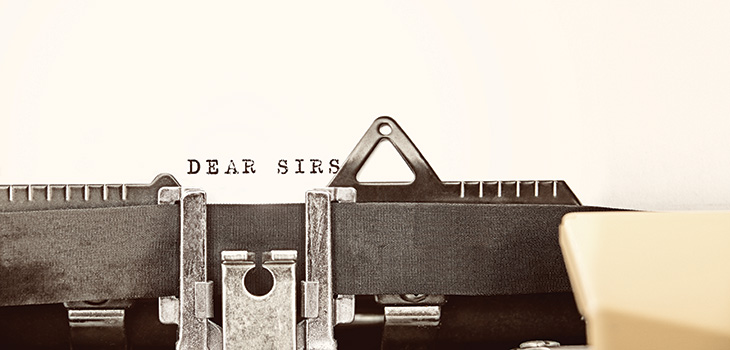
Farewell, Dear Sirs?

247600
© Getty images
Necessary progress or an erosion of professional formality? Thomas Boyce examines two small words that have prompted a big debate

Last October, when the Law Society released its updated guidance on inclusive language, much of the debate might reasonably have centred on diversity, unconscious bias and equality in the profession. Its ‘D&Ictionary’ encourages workplaces where colleagues can bring their whole selves. It challenges ingrained bias and embeds inclusivity into everyday practice.

Yet the aspect generating the most discussion is surprisingly narrow: the recommendation to stop opening letters with the traditional greeting ‘Dear Sirs’. At first glance, it seems minor, but this phrase sits at the intersection of professional ritual, social convention and the evolution of language itself. As the Oxford English Dictionary reminds us, language is never static: it adapts to reflect societal change, with definitions and phrases falling in and out of use over time. Viewed in this light, the debate over salutations is more than a question of etiquette; it is about how law mirrors society and the values

If you are not a subscriber, subscribe now to read this content
If you are already a subscriber sign in
...or Register for two weeks' free access to subscriber content

MOVERS & SHAKERS

Winckworth Sherwood—Rubianka Winspear

Winckworth Sherwood—Rubianka Winspear

Real estate and construction energy offering boosted by partner hire

Gateley Legal—Daniel Walsh

Gateley Legal—Daniel Walsh

Firm bolsters real estate team with partner hire in Birmingham

Shakespeare Martineau—Serena Eddy

Shakespeare Martineau—Serena Eddy

London restructuring team strengthened by legal director appointment

NEWS
A wave of housing and procedural reforms is set to test the limits of tribunal capacity. In his latest Civil Way column for NLJ this week, Stephen Gold charts sweeping change as the Renters’ Rights Act 2025 begins biting
Plans to reduce jury trials risk missing the real problem in the criminal justice system. Writing in NLJ this week, David Wolchover of Ridgeway Chambers argues the crown court backlog is fuelled not by juries but weak cases slipping through a flawed ‘50%’ prosecution test
Emerging technologies may soon transform how courts determine truth in deeply personal disputes. In this week's NLJ, Madhavi Kabra of 1 Hare Court and Harry Lambert of Outer Temple Chambers explore how neurotechnology could reshape family law
A controversial protest case has reignited debate over the limits of free expression. In NLJ this week, Nicholas Dobson examines a Quran-burning incident testing public order law
The courts have drawn a firm line under attempts to extend arbitration appeals. Writing in NLJ this week, Masood Ahmed of the University of Leicester highlights that if the High Court refuses permission under s 68 of the Arbitration Act 1996, that is the end
back-to-top-scroll