header-logo header-logo

07 January 2022
Categories: Legal News , Profession , Criminal
printer mail-detail

Legal Trainee Scheme—Solicitor Pathway

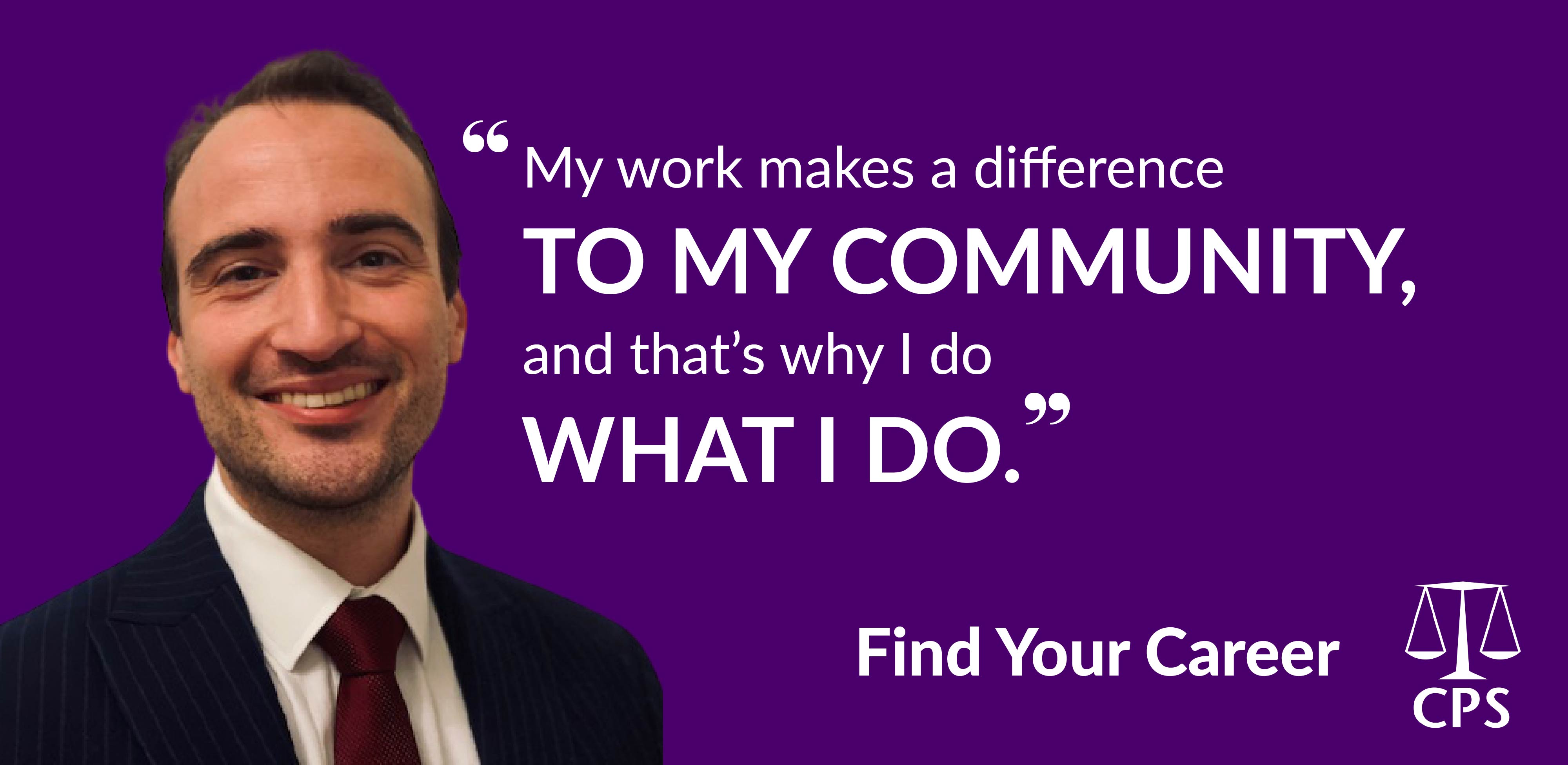
The Crown Prosecution Service (CPS) is delighted to share with you that the next CPS Legal Trainee Scheme (LTS) is open for applications

At the CPS, we are responsible for delivering justice through the independent and effective prosecution of crime. As the principal prosecuting authority across England and Wales the nature and diversity of cases we advise on and prosecute means our work is often emotionally challenging and complex. As such we employ over 6,000 individuals who think objectively, act professionally, show the upmost respect for others and continually strive for excellence.

The Legal Trainee Scheme, open for applications until Monday 31 January, offers positions to those with an interest in criminal law, and seeking to become fully qualified barristers or solicitors. Pupillage is one year in duration whilst the Period of Recognised Training takes two years to complete.

As a trainee solicitor for the CPS, you will have a variety of key responsibilities you will undertake, with supervision. These include reviewing and preparing cases; corresponding with other criminal justice system agencies, defence lawyers and counsel; providing advice to police on charging; and arranging and attending professional courses and undertaking activities to ensure that the Law Society training requirements are met.

Upon successful qualification, legal trainees will be offered permanent posts as Crown Prosecutors, where they will initially be based in a Magistrates Court Unit with the expectation that they will then gain the necessary skills and competence to apply for Senior Crown Prosecutor posts and beyond. This exciting pathway will be open across England and Wales, with a bi-lingual Welsh pathway also available.

Delivering justice is a complex pursuit with work that is sometimes emotionally challenging, which is why we offer a range of benefits including flexible working, civil service pension scheme, access to employee savings including high street retailer offers and discounts and 25 days leave, rising to 30 days after 5 years’ service.

If you are interested in kickstarting your career in criminal law, apply today.



Categories: Legal News , Profession , Criminal
printer mail-details

MOVERS & SHAKERS

Forbes Solicitors—Stephen Barnfield

Forbes Solicitors—Stephen Barnfield

Regulatory team boosted by partner hire amid rising health and safety demand

Arc Pensions Law—Kris Weber

Arc Pensions Law—Kris Weber

Legal director promoted to partner at specialist pensions firm

Clarke Willmott—Jonathan Cree

Clarke Willmott—Jonathan Cree

Residential development capability expands with partner hire in Birmingham

NEWS

From blockbuster judgments to procedural shake-ups, the courts are busy reshaping litigation practice. Writing in NLJ this week, Professor Dominic Regan of City Law School hails the Court of Appeal's 'exquisite judgment’ in Mazur restoring the role of supervised non-qualified staff, and highlights a ‘mammoth’ damages ruling likened to War and Peace, alongside guidance on medical reporting fees, where a pragmatic 25% uplift was imposed

Momentum is building behind proposals to restrict children’s access to social media—but the legal and practical challenges are formidable. In NLJ this week, Nick Smallwood of Mills & Reeve examines global moves, including Australia’s under-16 ban and the UK's consultation
Reforms designed to rebalance landlord-tenant relations may instead penalise leaseholders themselves. In this week's NLJ, Mike Somekh of The Freehold Collective warns that the Leasehold and Freehold Reform Act 2024 risks creating an ‘underclass’ of resident-controlled freehold companies
Timing is everything—and the Court of Appeal has delivered clarity on when proceedings are ‘brought’. In his latest 'Civil way' column for NLJ, Stephen Gold explains that a claim is issued for limitation purposes when the claim form is delivered to the court, even if fees are underpaid
The traditional ‘single, intensive day’ of financial dispute resolution (FDR) may be due for a rethink. Writing in NLJ this week, Rachel Frost-Smith and Lauren Guiler of Birketts propose a ‘split FDR’ model, separating judicial evaluation from negotiation
back-to-top-scroll