header-logo header-logo

NLJ this week: Assisted dying under the legal microscope

16 January 2026
Issue: 8145 / Categories: Legal News , Health , Human rights , Wills & Probate , Criminal
printer mail-detail
240110
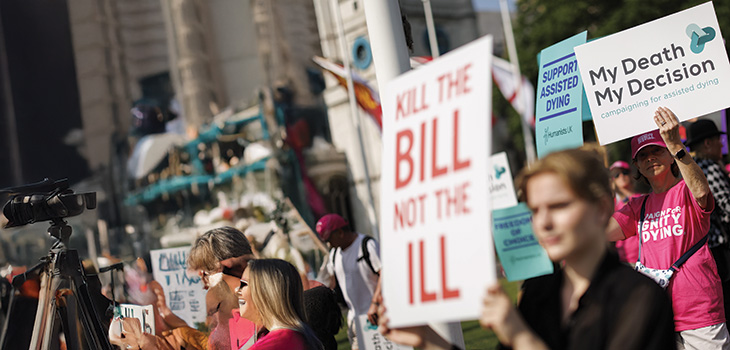
Assisted dying remains one of the most fraught fault lines in English law, where compassion and criminal liability sit uncomfortably close. Writing in NLJ this week, Julie Gowland and Barny Croft of Birketts examine how acts motivated by care—booking travel, completing paperwork, or offering emotional support—can still fall within the wide reach of the Suicide Act 1961

The article explains why prosecutions are rare but real, guided by DPP policy rather than immunity, and why inquests are increasingly the first legal reckoning for families and advisers alike. The civil consequences are just as stark: under the forfeiture rule, those who assist may lose inheritance rights unless courts exercise discretion.

Against this backdrop, the authors assess the Terminally Ill Adults (End of Life) Bill, now before the Lords, questioning whether its safeguards and reliance on medical judgement truly reflect modern medical reality. Until reform arrives, practitioners must navigate a regime that criminalises conduct many see as humane.

RELATED ARTICLES

MOVERS & SHAKERS

WSP Solicitors—Amie Williamson

WSP Solicitors—Amie Williamson

Gloucestershire firm boosts residential conveyancing team

mfg Solicitors—Andrew Johnson

mfg Solicitors—Andrew Johnson

Firm strengthens corporate team in Worcester with new hire

London Market FOIL—Ling Ong

London Market FOIL—Ling Ong

Weightmans partner appointed president of London Market Forum of Insurance Lawyers

NEWS
From gender-critical speech to notice periods and incapability dismissals, employment law continues to turn on fine distinctions. In his latest employment law brief for NLJ, Ian Smith of Norwich Law School reviews a cluster of recent decisions, led by Bailey v Stonewall, where the Court of Appeal clarified the limits of third-party liability under the Equality Act
Non-molestation orders are meant to be the frontline defence against domestic abuse, yet their enforcement often falls short. Writing in NLJ this week, Jeni Kavanagh, Jessica Mortimer and Oliver Kavanagh analyse why the criminalisation of breach has failed to deliver consistent protection
Assisted dying remains one of the most fraught fault lines in English law, where compassion and criminal liability sit uncomfortably close. Writing in NLJ this week, Julie Gowland and Barny Croft of Birketts examine how acts motivated by care—booking travel, completing paperwork, or offering emotional support—can still fall within the wide reach of the Suicide Act 1961
The long-awaited Getty Images v Stability AI judgment arrived at the end of last year—but not with the seismic impact many expected. In this week's issue of NLJ, experts from Arnold & Porter dissect a ruling that is ‘historic’ yet tightly confined
The UK Supreme Court may be deciding fewer cases, but its impact in 2025 was anything but muted. In this week's NLJ, Professor Emeritus Brice Dickson of Queen’s University Belfast reviews a year marked by historically low output, a striking rise in jointly authored judgments, and a continued decline in dissent. High-profile rulings on biological sex under the Equality Act, public access to Dartmoor, and fairness in sexual offence trials ensured the court’s voice carried far beyond the Strand
back-to-top-scroll