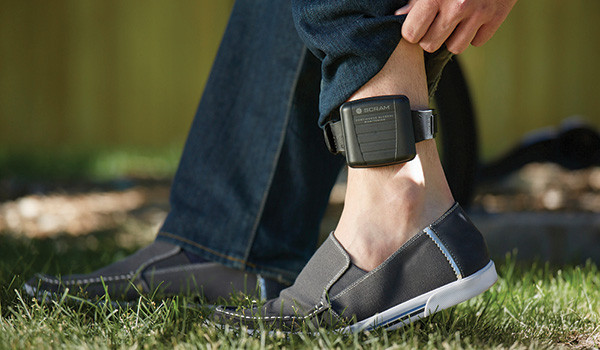
How does SCRAM CAM work?
SCRAM CAM or SCRAM is an alcohol monitoring bracelet worn around the ankle. It uses 24/7 transdermal analysis to detect traces of alcohol in sweat and can be used as an alternative to, or complement, other forms of alcohol testing.
The bracelet takes readings every 30 minutes and stores the data automatically. As it can register very low levels of alcohol consumption (1-2 units), it provides a highly accurate insight into a participant’s drinking activity over a defined period.
It is increasingly used as a transitioning measure where alcohol testing has been undertaken, but ongoing drinking behaviour needs to be monitored.
Who would benefit from SCRAM?
SCRAM can be used to support treatment or enhance supervision in many different scenarios, including:
- Domestic violence cases, where alcohol is a contributing factor
- Drug users, who often turn to alcohol once they are actively being tested for drugs
- Individuals with alcohol-dependency issues
- Family Court, to assess the level of a parent’s alcohol problem, or gather evidence to support acceptable drinking behaviours
- Custody conditions or child visitation arrangements - particularly beneficial over the festive season
A good recent example is that of Callum (not his real name), whose previous alcohol misuse had left his ex-partner concerned about the impact this could have on their two young children. As a result, the court limited visitation rights until Callum could demonstrate his commitment to sobriety.
Callum agreed to wear the SCRAM bracelet over a period of three months, and reports from the device confirmed that he had remained alcohol-free throughout that period.
The court was satisfied that Callum was reliably abstinent, and granted him supervised contact with his children, with the possibility of unsupervised contact in the future.
By using SCRAM, Callum was able to demonstrate his progress in recovery, leading to a positive outcome for both him and his children.
How much does SCRAM cost and who pays for it?
SCRAM is Legal Aid Agency approved, meaning that legal aid funding shouldn’t be an issue when court orders are obtained.
At AlphaBiolabs, we have simplified our SCRAM pricing structure, with no hidden costs to pay once you have obtained a quote from us.
Our Price Promise means we will also match any like-for-like quote and beat it by a further 10%, meaning that we will always offer the most competitive pricing in the UK.
Does SCRAM have anti-tamper technology?
It is not unknown for clients to try and ‘trick’ SCRAM by placing objects between the bracelet and the ankle, by submerging it in water, or by using lotions, oils and alcohol-containing products to try and interfere with its performance.
However, SCRAM includes several anti-tamper features to maintain testing accuracy, including temperature, infrared, strap, and battery sensors.
SCRAM also performs continuous diagnostic tests to ensure the unit is functioning properly. So if someone wearing a SCRAM bracelet tries to tamper with it, we will know!
Can spilling alcohol on the bracelet cause a false positive?
It is very unlikely that spilling alcohol on the bracelet would generate a false positive.
The system is designed to distinguish between environmental exposure, and alcohol that metabolises through the skin: spilling a drink or product containing alcohol would create a spike much faster than if the wearer had consumed alcohol.
Our confirmation process includes careful analysis to ensure that any alerted drinking events occurred due to alcohol consumption, not environmental exposure.
Continuous, real-time monitoring
We have over 20 years’ experience providing court-ordered alcohol testing services and offer a wide range of solutions for ongoing alcohol monitoring, including SCRAM.
Our in-house experts are trained to fit and remove the bracelet at your client’s home, and a wireless base station is installed to record readings automatically from data stored in the bracelet.
More reasons to choose AlphaBiolabs & SCRAM:
- UKAS ISO 17025-accredited laboratory
- Fittings arranged within 24-48 hours of instruction, subject to client availability
- Most competitive pricing structure in the UK
- Invoiced monthly with split-invoice option available if required
- Notifications of alcohol consumption within 24 hours of a confirmed event
- Can be worn for as long as required
Weekly or monthly court-approved & user-friendly reports
Register now for one of our FREE 30-minute webinars on Tuesday 19 November at 12 noon or Thursday 21 November at 9am, where you can learn even more about SCRAM.
Legal clients can also claim 15% off SCRAM until 31 December 2024. Simply cite SCRAM15 when placing an order.
Any additional sample collections for drug or alcohol testing will also be FREE when collected at the SCRAM bracelet fitting appointment.
To request a quote call our New Enquiry team on 0333 600 1300, email testing@alphabiolabs.comor complete our online form, and we will be happy to discuss your requirements.