


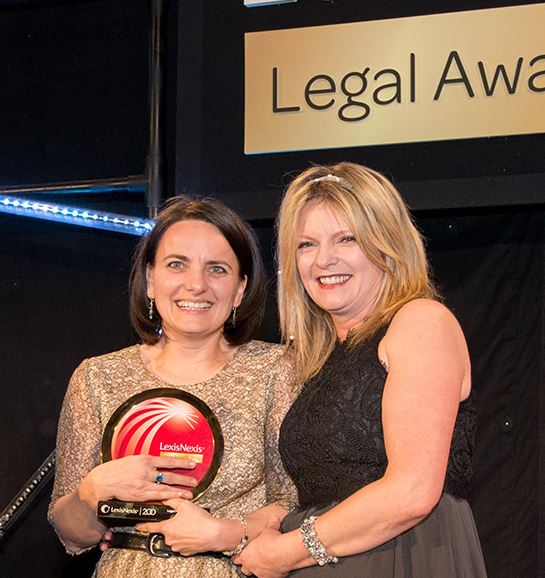
The LexisNexis Legal Awards 2019 are currently open for entries and one of the most prestigious of the 15 categories on offer is the Legal Personality of the Year award, which honours the individual who has made the most outstanding contribution in the legal sphere over the past year. This person needn’t necessarily have a legal background or qualification—last year’s winner was Dana Denis-Smith (pictured, left), the founder of the First 100 Years project which showcases the contribution of women to the law—but their actions should have had a significant impact upon the development of the law or its practice over the previous twelve months.
So, who are the leading contenders for the 2019 award? We’ve set out some suggestions below, but perhaps there are other deserving candidates that you would like to nominate?
May 2018
Following a victory in the Supreme Court, Sapna Malik, partner at Leigh Day, secured an apology from the prime minister for her clients Abdul-Hakim Belhaj and his wife Fatima Boudchar for their unlawful rendition to Libya in March 2004.
In a letter read out in the Commons, Prime Minister Theresa May stated that the UK 'should have done more to reduce the risk' of the pair being mistreated, adding: 'We accept this was a failing on our part. On behalf of Her Majesty's government, I apologise unreservedly.'
The historic settlement marks the first time that ministers have apologised for a specific act involving British security agencies.
June 2018
The Supreme Court ruled in favour of a heterosexual couple, Rebecca Steinfeld and Charles Keidan, in their challenge against legislation which prevents opposite-sex couples from entering into a civil partnership. For Louise Whitfield, partner at Deighton Pierce Glynn, this represented the culmination of three and a half year’s work on behalf of her clients.
With the court ruling unanimously that the current situation breached the Human Rights Act, the government subsequently agreed to change the law.
July 2018
Family lawyer Edward Cooke won a three-year long battle to save Chichester Court after the HM Courts and Tribunal Service agreed to hold hearings in the district council building as an alternative to the existing court building, which had been earmarked for closure in February 2016.
With the Ministry of Justice closing around 200 courts in the past eight years, Cooke said that the Chichester campaign should be a blueprint for people trying to fight future battles, stating: 'I hope the example of Chichester will inspire other towns and cities faced with losing essential local justice facilities not to give up'.
August 2018
In the first Supreme Court case to be heard in Northern Ireland, the Court ruled that Siobhan McLaughlin, an unmarried mother of four from County Antrim, whose partner John Adams had died in 2014, should be entitled to receive Widowed Parent’s Allowance.
A team from Herbert Smith Freehills, led by Andrew Lidbetter, acted on a pro bono basis representing the Child Poverty Action Group in the charity’s intervention in the case. The decision, which placed paramount importance on the needs and welfare of children, was also hailed as a significant step towards reforming the rights of cohabitees and ‘common-law’ spouses.
October 2018
Finally, in the so-called 'gay cake' case, the Supreme Court ruled that Ashers bakery could not be held liable for refusing to express an opinion that was contrary to their religious beliefs. Ashers were represented by Belfast-based barrister David Scoffield QC, Sarah Crowther QC of Outer Temple Chambers and Christopher McCrudden, who is Professor of Human Rights and Equality Law at Queen’s University Belfast.
Some commentators, such as human rights campaigner Peter Tatchel, regarded the ruling as an important victory for freedom of expression and freedom of ideas.
If you would like to nominate any of these candidates—or have some suggestions of your own—please submit your entries online at www.lexisnexislegalawards.co.uk by the closing date of Friday 16 November. The judges will then select a shortlist from these entries, with the eventual winner being decided by an online vote of the New Law Journal readership.


