

THIS ISSUE
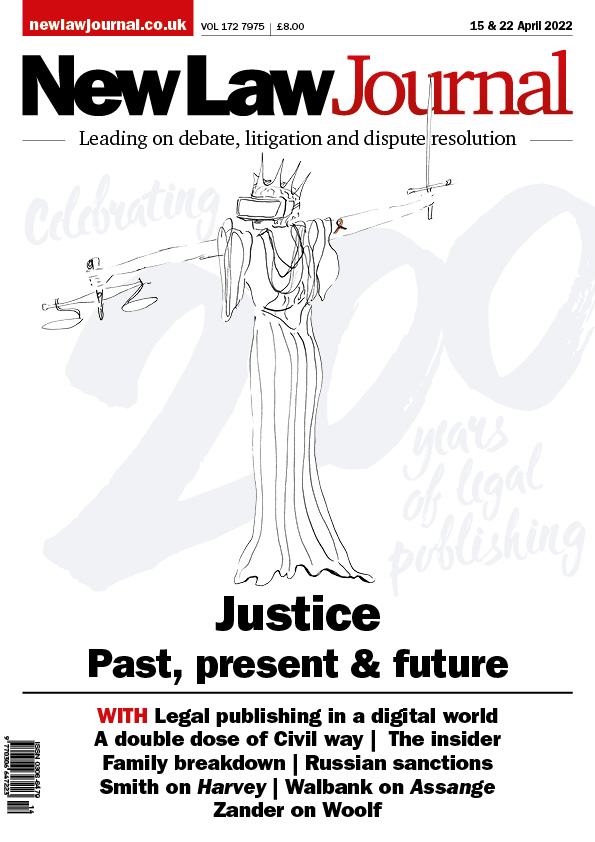

Who will be the next Lord Chief Justice? Place your bets but be sure to read Professor Dominic Regan’s tips first, in this week’s NLJ
Former District Judge Stephen Gold covers publicans untied, divorce costs and financial remedy pilots in this week’s Civil Way
Solicitors have raised questions about the Legal Services Board’s (LSB) plans to help consumers compare the market on fees, pricing models and costs
Criminal defence solicitors have been issued with guidance as their colleagues at the Bar began a ‘no returns’ policy this week
The Solicitors Indemnity Fund (SIF) could be granted a 12-month reprieve, following a robust response to a consultation on its future
The Ministry of Justice (MoJ) has made ‘swift access to justice’ one of its key goals, in its Digital Strategy for 2022 to 2025
The Court of Appeal has fired off a second warning to counsel about lack of discretion, this time in a matter concerning a former MP who sought anonymity for domestic abuse allegations
Criminal barristers have ploughed ahead with protest action, after the Ministry of Justice (MoJ) refused to increase fees and hourly rates by 25%

MOVERS & SHAKERS


Clyde & Co—Suriya Ashok
Clyde Co strengthens energy transition and construction offering with hire of Suriya Ashok

Jurit—Nicole Gallop Mildon
Jurit appoints rare dual-qualified lawyer to expand Anglo-French private wealth expertise

Twenty Essex—Thomas Hibbs, Jack Hollingworth & Sam Pearce
Three new tenants join Twenty Essex
NEWS
The Financial Reporting Council’s revised Audit Enforcement Procedure will alter the balance of power in corporate investigations
A telecoms operator may be able to hold over under the Landlord and Tenant Act 1954, yet still be unable to secure a renewal: an outcome described as a legal ‘paradox’
Safety fears do not automatically justify shutting an interested person out of a statutory will application
Consumer credit law is heading for its biggest shake-up in 50 years, with the Consumer Credit Act 1974 set to yield much of its detailed statutory machinery to FCA rules
The Supreme Court has settled a long-running dispute over part-time workers: unfavourable treatment need be a significant or effective cause, not the sole cause
Copyright © 2026 LexisNexis

