

THIS ISSUE
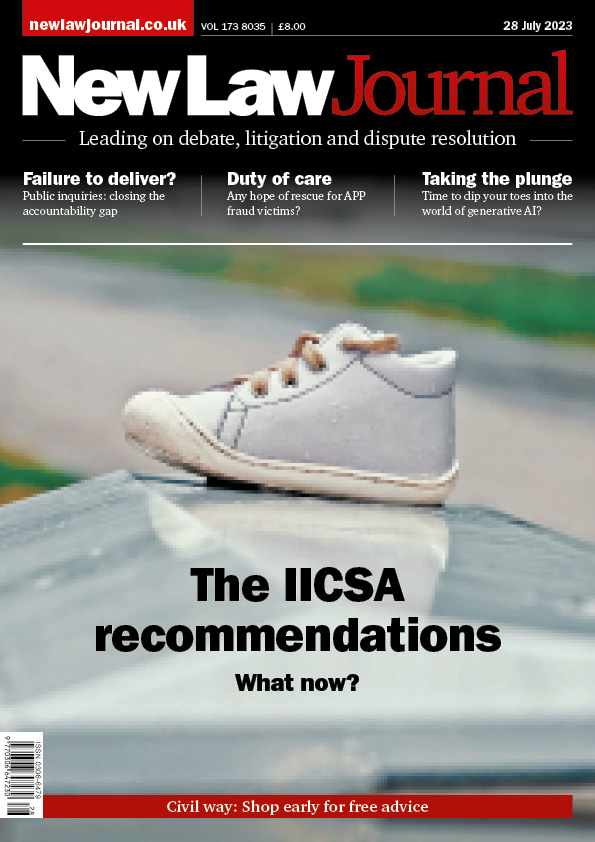

The much-anticipated ruling of the Supreme Court in Philipp v Barclays Bank, which overturned the Court of Appeal’s decision, is discussed from the perspective of consumer safeguarding, in this week’s NLJ.
In this week’s NLJ, Maryam Syed, criminal and family barrister at 7BR, discusses the path forward for those who feel let down by the government’s response to the Independent Inquiry into Child Sexual Abuse (IICSA).
In product liability claims, including those involving medical safety issues, ‘many claimants have had to endure decades of litigation, campaigning and lobbying in order to make their voices heard’, Hausfeld lawyers Sarah Moore, partner, Stuart Warmington, senior associate, and Lily Parmar, legal assistant, write in this week’s NLJ.
Lack of personnel is creating havoc in court. In this week’s NLJ, former district judge Stephen Gold writes on ‘the mess’ in family courts where ‘frequent and widespread difficulties’ are arising due to a shortage of qualified legal representatives to cross-examine vulnerable witnesses.
What are the key considerations for firms thinking about using generative artificial intelligence (AI)? In this week’s NLJ, Alex Smith, global product lead at iManage, sets out the main issues to bear in mind.

Other countries must exercise caution when drawing inspiration from the UK’s Criminal Cases Review Commission, Jon Robins argues
Public inquiries related to product liability do vital work but are undermined by a lack of accountability & commitment to action, as Sarah Moore, Stuart Warmington & Lily Parmar explain
Should a charity’s entire premises attract business rate relief, or just those that benefit the public directly? Nicholas Dobson examines a recent case
The Supreme Court has not rescued consumers who are the victims of APP fraud, but neither has it left them wholly unprotected: Michael Brown, Charlie Shillito & David McIlroy report on the judgment in Philipp v Barclays Bank
Cross-examiner crisis; new possession help; interest on costs; bank liability for fraud.

MOVERS & SHAKERS


Harneys—Maggie Kwok & George Weston
Harneys senior leadership appointments

Freeths—Keith Browne & Jim Jordan
Freeths strengthens London Construction and Engineering practice with two strategic senior hires

Anthony Collins—Laura Moss
Anthony Collins announces strategic hire to deepen skills base in the social business sector
NEWS
More than 100 teams from the legal and financial services sectors competed in five sports at the 51st Law Society RFC Festival of Sport earlier this month
Part-time status need only be an effective cause of less favourable treatment, rather than the sole cause, the Supreme Court has held in Augustine v Data Cars
Britain’s new acknowledgement that Israel’s occupation is unlawful, and accompanying settlement-goods ban and sanctions, is significant but overdue, argue Danny Friedman KC and Victor Kattan in NLJ this week
New planning fee rises, wider trade union access rights and a service-by-email trap feature in Stephen Gold’s latest Civil Way
Existing defamation law can respond to AI ‘hallucinations’, but allocating responsibility will prove harder where outputs reach users without human intervention
Copyright © 2026 LexisNexis

