

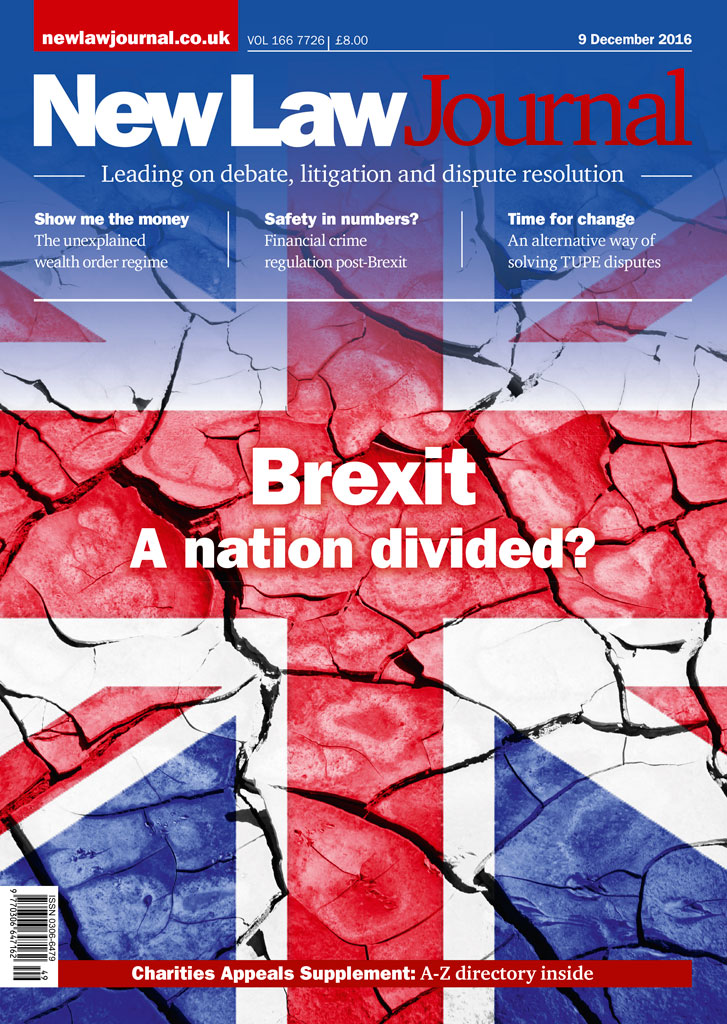


Clare Arthurs & Richard Marshall share an (almost) A-Z of cross border disputes, post-Brexit
John McMullen discusses TUPE & service provision change disputes
In a second in a series of articles, Frank Maher advises upon how to discover rogue partners & employees
Qader and others v Esure Services Ltd; Khan and another v McGee [2016] EWCA Civ 1109, [2016] All ER (D) 156 (Nov)
Athelstane Aamodt examines the new CPS guidance on cases involving communications sent via social media
Jon Holland & Catherine Robert forecast the implications of Brexit for financial crime regulation
Azur Space Solar Power GmbH v European Union Intellectual Property Office T-614/15 , [2016] All ER (D) 14 (Dec)
R (on the application of K and others) v Secretary of State for Defence and another [2016] EWCA Civ 1149, [2016] All ER (D) 133 (Nov)
Jonathan Pickworth & Jonah Anderson examine the proposed unexplained wealth order regime
Hamilton v Kuoni Travel Ltd [2016] EWHC 3090 (QB), [2016] All ER (D) 13 (Dec)

MOVERS & SHAKERS


Browne Jacobson—Caroline Barker & Tom Walker
Browne Jacobson recruits regulatory experts Caroline Barker and Tom Walker to bolster health, government and corporates practices

Jackson Lees Group—Paul Harrison, Helen Innes & Sorcha McMullan
Partner and paralegals bolster clinical negligence team at Jackson Lees Group

Stone King—Manchester
Stone King triples Manchester footprint with office move as law firm’s rapid growth journey continues

