

THIS ISSUE


The long-awaited Getty Images v Stability AI judgment arrived at the end of last year—but not with the seismic impact many expected. In this week's issue of NLJ, experts from Arnold & Porter dissect a ruling that is ‘historic’ yet tightly confined
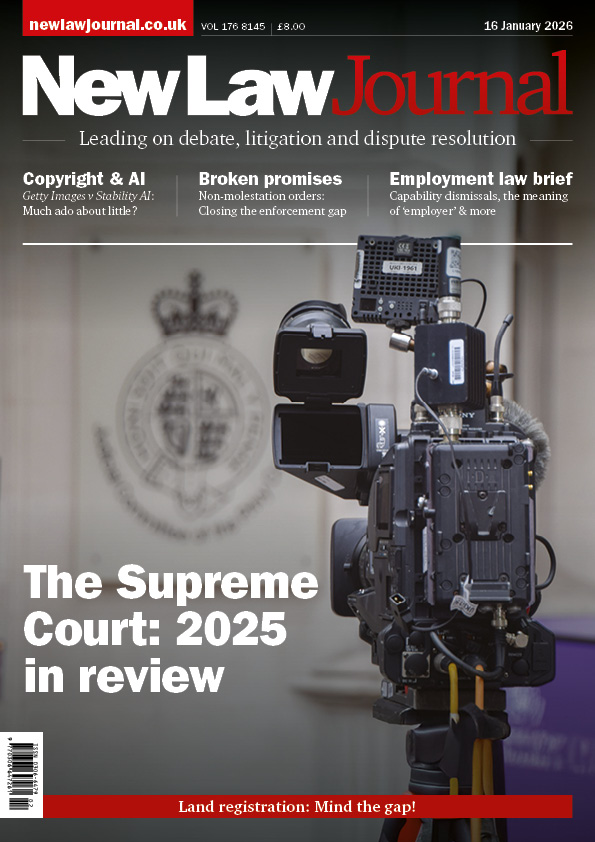
The UK Supreme Court may be deciding fewer cases, but its impact in 2025 was anything but muted. In this week's NLJ, Professor Emeritus Brice Dickson of Queen’s University Belfast reviews a year marked by historically low output, a striking rise in jointly authored judgments, and a continued decline in dissent. High-profile rulings on biological sex under the Equality Act, public access to Dartmoor, and fairness in sexual offence trials ensured the court’s voice carried far beyond the Strand
Delays at HM Land Registry are no longer a background irritation but a growing source of professional risk. Writing in NLJ this week, Phil Murrin of DAC Beachcroft explores how the ‘registration gap’—now stretching up to two years in complex cases—is fuelling client frustration, priority disputes, and negligence claims

Quieter court, louder consequences? Brice Dickson analyses the output of the Supreme Court in 2025
The extension of fixed recoverable costs (FRC) from low-value personal injury to most civil cases worth up to £100,000 ‘is failing to deliver what it promised’, the Law Society has warned
Bar campaigns will focus on protecting juries, legal aid and children’s rights in the year ahead with a working group already looking into the age of criminal responsibility, chair Kirsty Brimelow KC has said
Richard Orpin has been appointed chief executive officer (CEO) of the Legal Services Board (LSB), which oversees all nine legal regulators
Workers will be given day-one rights to parental leave in April, the government has confirmed
Tech enthusiast and second most senior judge in England and Wales, Sir Geoffrey Vos, Master of the Rolls, is retiring from the judiciary at the end of October
Ministers’ proposals to raise funds by seizing interest on lawyers’ client account schemes could ‘cause firms to close’, solicitors have warned


MOVERS & SHAKERS


Harneys—Maggie Kwok & George Weston
Harneys senior leadership appointments

Freeths—Keith Browne & Jim Jordan
Freeths strengthens London Construction and Engineering practice with two strategic senior hires

Anthony Collins—Laura Moss
Anthony Collins announces strategic hire to deepen skills base in the social business sector
NEWS
More than 100 teams from the legal and financial services sectors competed in five sports at the 51st Law Society RFC Festival of Sport earlier this month
Part-time status need only be an effective cause of less favourable treatment, rather than the sole cause, the Supreme Court has held in Augustine v Data Cars
Britain’s new acknowledgement that Israel’s occupation is unlawful, and accompanying settlement-goods ban and sanctions, is significant but overdue, argue Danny Friedman KC and Victor Kattan in NLJ this week
New planning fee rises, wider trade union access rights and a service-by-email trap feature in Stephen Gold’s latest Civil Way
Existing defamation law can respond to AI ‘hallucinations’, but allocating responsibility will prove harder where outputs reach users without human intervention
Copyright © 2026 LexisNexis

