

THIS ISSUE
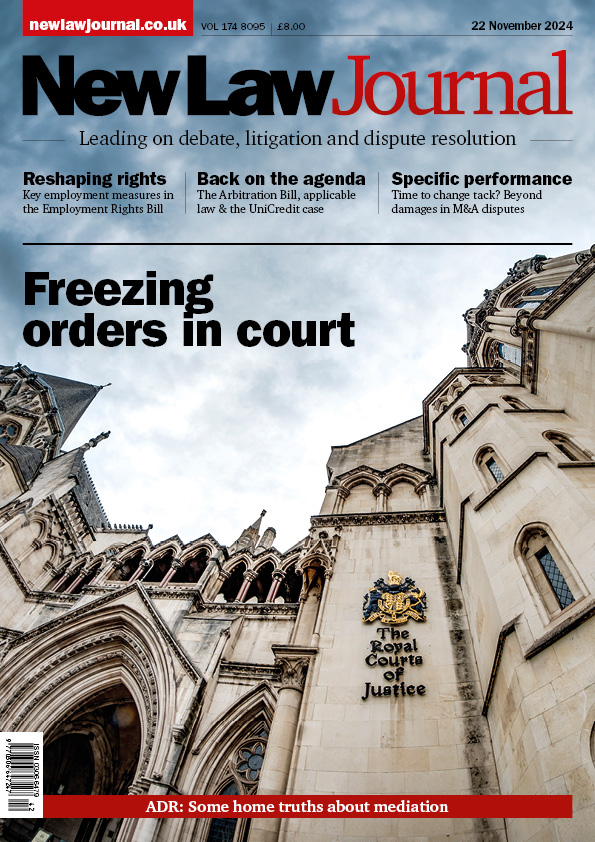

Freezing injunctions are 50 years old next year and still very much a developing area of law. In this week’s NLJ, Mary Young, partner, and Charlotte Dormon, associate, in the dispute resolution team at Kingsley Napley, take us through a raft of cases decided this year.
Should an immoral regime rise to power, it is tempting to think lawyers and the rule of law would act as a protective wall. But is this true? Sadly, history suggests not, as John Gould, chair of Russell-Cooke, writes in this week’s NLJ.
Retired costs judge John O’Hare discusses ADR in three contexts, in this week’s NLJ. He covers cases provisionally allocated to the small claims track, commercial litigation in the County Court, and claims opposed by liability insurers or by large self-insuring organisations such as local authorities or health authorities.
Ambiguity over the governing law of arbitration agreements continues to spark debate. In July, meanwhile, the government reintroduced the Arbitration Bill, which would have altered the outcome in September of the Supreme Court case, UniCredit. In this week’s NLJ, Valya Georgieva, senior associate, Penningtons Manches Cooper, and Ravi Aswani, barrister, 36 Group, examine the court’s reasoning and consider how the outcome might have differed if the Arbitration Bill, currently before Parliament, had been in force.
The remedy of ‘specific performance’ is little-used but can be ‘extremely beneficial’ in M&A disputes. In this week’s NLJ, Yasseen Gailani, partner, and Megan Hiluta, senior associate, Quinn Emanuel, explain why looking beyond the remedy of damages may pay dividends for clients.

In a system ruled by immoral leaders, it may be fanciful to believe that lawyers can or will make a difference: John Gould considers a chilling lesson from history
Even after five decades of freezing injunctions, the courts are still regularly asked to clarify the law: Mary Young & Charlotte Dormon round up this year’s causes of confusion
Charles Pigott outlines key employment measures contained within the government’s Employment Rights Bill
Yasseen Gailani & Megan Hiluta consider the advantages of the little-used remedy of ‘specific performance’
The Arbitration Bill is back on the agenda—but how would it have affected the outcome of the UniCredit case? Valya Georgieva & Ravi Aswani consider the implications

MOVERS & SHAKERS


Harneys—Maggie Kwok & George Weston
Harneys senior leadership appointments

Freeths—Keith Browne & Jim Jordan
Freeths strengthens London Construction and Engineering practice with two strategic senior hires

Anthony Collins—Laura Moss
Anthony Collins announces strategic hire to deepen skills base in the social business sector
NEWS
Existing defamation law can respond to AI ‘hallucinations’, but allocating responsibility will prove harder where outputs reach users without human intervention
The High Court has upheld a rare successful serious-irregularity challenge after an arbitrator relied on an implied term neither party had advanced
Thirty years after The Future of Law shook a profession still using fax machines, its central forecast looks increasingly less like prophecy and more like description
More than 100 teams from the legal and financial services sectors competed in five sports at the 51st Law Society RFC Festival of Sport earlier this month
Part-time status need only be an effective cause of less favourable treatment, rather than the sole cause, the Supreme Court has held in Augustine v Data Cars
Copyright © 2026 LexisNexis

